
I’m writing this from a rocky road in the Andes – the Sacred Valley, to be a bit more specific. At 9,000 feet of elevation, the sky is bright blue and the sun bakes everything it touches. The trees are a fascinating mix of tropical (palms), desert (cacti), and gently swaying eucalyptus; hummingbirds flit from flower to flower completely unconcerned with us mere tourists. And the peaks are astounding – even the gentlest of the slopes feel sheer, and a short walk up stone steps literally takes your breath away.
And of course, there are llamas and alpacas everywhere you look, grazing contentedly. (Once in a while, one gets the zoomies, and woe betide any groundskeeper or tourist in its path!)
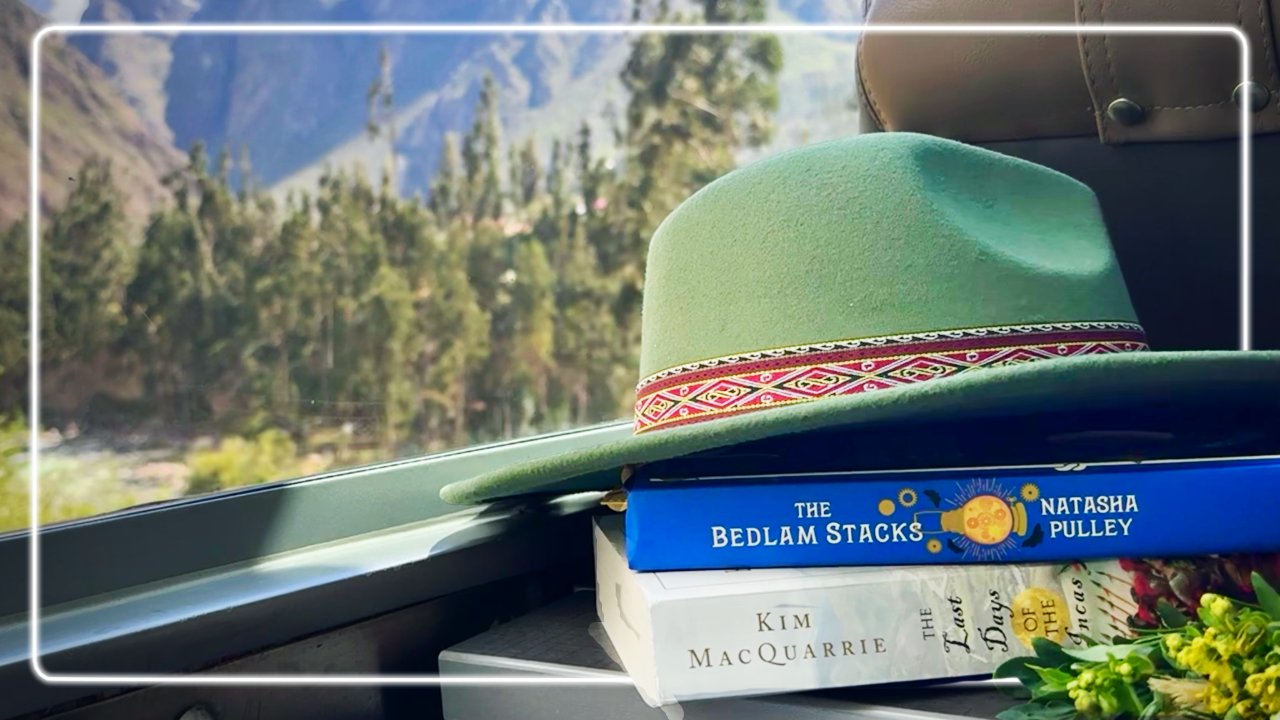
It’s in this valley, glaciers peeking through the mountaintops, that I sat down with my designated books for the trip: Kim McQuarrie’s The Last Days of the Incas, and Natasha Pulley’s The Bedlam Stacks. The former was my Designated History Reading – my favorite change in reading habits since last year; the latter, my fantasy treat.
The last days of an Empire

I started with the medicine – because, as much as I’ve opened up to more historical reading, the conquistadors have never been my favorite subject. It’s always so bloody, so needlessly greedy, and I can’t help but wonder, what if things had gone a different way? But I was intrigued by McQuarrie’s premise – to retell the story of the final few decades of the Incan civilization, including years of guerilla warfare against the Spanish.
McQuarrie is a clear, enjoyable writer, and I found myself swallowing my medicine with ease. I particularly enjoyed the time he spent explaining sociology-cultural elements of the history – primarily of the Inca, but also of the Spanish conquistadors and their motivations. From Atahualpa’s despair upon realizing that, despite Pizarro’s promises, he would never rule again to Manca Inca’s evolution from eager teen to world-weary guerilla leader, The Last Days of the Incas contained plenty of human emotion, almost operatic in its drama.
I found the battles less interesting, though in retrospect it’s hard to suggest which to skip. I’ve never been one to enjoy battle sequences, and this story is full of them – the Inca battling the Spanish, and occasionally the Spanish battling each other. Perhaps the biggest source of frustration – the reality of the Inca, time and time again, over-trusting and paying the price in bloodshed – could not be helped by McQuarrie, as it’s just historical fact. And perhaps, too, that frustration was necessary, to make critical moments of cleverness all the sweeter – I almost cheered when someone finally realized that bolos, most often used in hunting deer and their kin, could also be effective against horses. Reading in the Andes also drove home exactly why horses would struggle in these mountains, which I would not have appreciated back in the mild hills of the Bay.
A journey for chinchona
Having finished with my history, I turned to my sugar – just in time for our train through the valley to Machu Picchu. This meant I got to read about the quest to retrieve cinchona from Peru while traveling through Andean cloud forests… not perfect scene-setting but pretty darn close.
Natasha Pulley’s The Bedlam Stacks tells a fictional, fantasy retelling of the expedition for cinchona (used to make quinine). Her protagonist, Merrick Tremayne, is a keen botanist and experienced smuggler, whose family spent several years in Peru. He accompanies (real-life) anthropologist Clements Markham over the Andes into no-man’s land on a quest to liberate a few viable cuttings of cinchona – which the Peruvian government has, to date, maintained a monopoly over.

The storytelling in The Bedlam Stacks is slow-paced and full of striking visuals. From the depths of Cornwall to a snowy Andean village, and all the remote lands in between, Pulley paints a vivid landscape. Her protagonists are intriguing, though at times inconsistent with prior characterization. Overall, the pacing is slow, until it rapidly shifts to get through the end. This is a story that operates in vibes, not logic – perhaps a bit funny for one focused on the Inca civilization, which seemed eminently logical.
The story also explores colonialism, albeit with a light touch. Tremayne is, decidedly, a colonialist – he works for the East India Company as a smuggler, he’s initially dismissive of the locals he meets. While he learns to love Bedlam and its residents, one can’t help but wonder if he’d have the same reaction were no magic involved. But he’s also the most curious of the colonialists we meet. His foils are, after all, Clements Markham, a bad translator and a dismissive anthropologist, and Martel, a vicious Spanish cinchona monopolist. Both insist on framing their surroundings in European terms – dismissing local traditions as mere superstition – and end up paying for it. Compared to them, Tremayne seems a panacea of curiosity.
A city of layers
The real benefit of all this reading hit home as we explored Cusco and its surrounds. Having a decent understanding of Inca history allowed me to focus on the cultural elements of all the different sites; having read about multiple periods of that history allowed me to better appreciate the strata of Cusco.
For Cusco is a city of layers, Republican hopes and dreams stacked on Spanish conquest architecture, itself built upon Inca foundations. Perhaps nowhere better exemplifies this than Qorikancha – originally, the primary temple of the sun in the Inca capital, now a Dominican church. It’s a striking edifice, made more so when thinking about how, per McQuarrie, three conquistadors stripped the walls bare of all the gold they could find. Across the street is a Marriott, formerly the home of the worst Pizarro, who himself took it from the Inca elite. We also visited during Corpus Christi, a religious festival in which the Catholic Church re-imagined an annual sun festival involving a procession of mummies to become a procession of neighborhood saints. The saints, intricately decorated statues, process around a central statue of Pachacútec, and enter the cathedral for a mass in Runa-Simi. Layers, everywhere you care to look.
In this way, Cusco reminds me of Rome. And like Rome, while there’s already plenty to explore on the surface of the city – the locals are now extremely proud of native culture and it’s proudly demonstrated in art and shows and the many archaeological sites nearby – everything is made richer when you know the many stories that lie underneath.
We started our own journey with Machu Picchu, which stood as an incredible contrast to the rest of the sites in the area. Unlike much of Cusco and the Sacred Valley, Machu Picchu went untouched by the Spanish for centuries. This means that, aside from archaeological shenanigans, it’s a relatively “pure” way to see an example of Inca architecture – the scale of it, the different cultures brought together in one site. Starting there allowed me to have a better appreciation of the strata I would see in Cusco – and that I had read about in McQuarrie. And of course, seeing it in contrast to, say, Ollantaytambo brought to life the mystery of Vilcabamba – why so many debates were had over its potential role in the time of the Inca resistance.


Returning to my roots
I continue to be so thankful that I’ve started to read more location-based books; nonfiction especially. This has been an amazing trip – all the better for reading so much while actually in Peru. But it will be the last big trip for a while, and in many ways I’m excited to return to more of the regular routine.
Until next time – stay cozy, and stay curious!
