
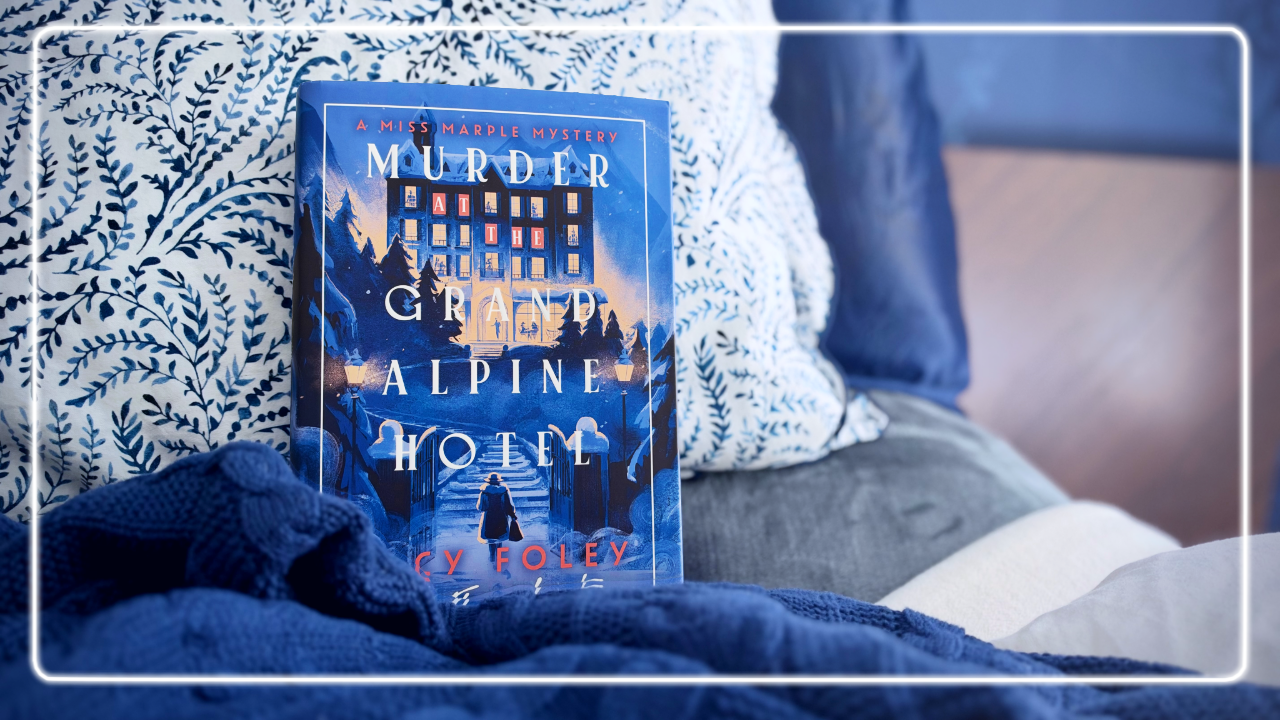
This blog started with Miss Marple, who continues to be my favorite female sleuth of all time. And so of course I had to read the new continuation novel, Murder at the Grand Alpine Hotel. And of course I’m here, sharing my thoughts with you.
This new book is, effectively, an adaptation of Agatha Christie’s original character Miss Marple. In it, our heroine Miss Marple and her best friend Dolly Bantry take a trip to the Grand Alpine Hotel for what they hope will be a lovely winter retreat. Unfortunately, murder quickly ensues, and Miss Marple can’t resist digging in. She uncovers tons of post-war intrigue: there’s hidden treasure, secret families, spy rings, and skiing nuns. But how well does all of this compare to the source material?
Because it’s an adaptation (albeit a print one, rather than one for film), I’ll use my usual rubric: how does it hold up as a story / mystery, and how does it hold up as a Miss Marple story? Can Foley write a Miss Marple story from a modern seat, with modern plot devices?
Post-war plots in an Alpine chalet
Let’s start with the mystery. Murder at the Grand Alpine Hotel opens with a dead body in a gondola, told from the perspective of the gondola attendant discovering him. After lingering on the surprise and horror of the scene, the narrative shoots back to the start of Miss Marple’s journey to the hotel, accompanied by Dolly Bantry (of St. Mary Mead fame) and her companion, Diana. The narrator shifts every few chapters, until we build up a view of the full cast at the Grand Alpine Hotel: the companion, the politician’s wife, his shady friend, the scandalous actress, and more. Murder ensues, the hotel gets cut off from the outside world via weather, and then it’s up to Miss Marple (and the local police) to figure out whodunnit.
So how does it hold up as a mystery?
Foley’s writing is engaging and her characters are fun (if not always pleasant) to be around. In writing the story, she’s stuffed it full of post-WWII intrigue, from the glitz and glam of film to hidden treasure troves. In doing so, she’s worked to create a variety of avenues for the murder and its motive: did the victim die for love, money, or something more sinister? The result, however, is a fast-paced hodgepodge of stuff – it’s like reading every single post-war adventure story rolled into one. As a frequent reader of books set in this era, I often found myself wondering how all of this would tie up in a satisfying way. Pacing-wise, Foley’s writing half a mystery, half a thriller, with tons of suspenseful action sequences that take advantage of the brutal setting.
The solution itself is, while technically clued in the story, not strictly fair play. Perhaps equally importantly, it doesn’t come with a sense of understanding. There’s no lovely “click” as all the pieces fall into place and you realize why this is the only solution that actually worked – either emotionally or physically. Ultimately, the thriller wins out as Foley uses the setting to craft a dramatic ending sequence, which likely works well for many modern mystery readers. But for those wanting a Golden Age mystery experience – one where the climax is about character and puzzle more than adventure – you may walk away less satisfied.
What makes Miss Marple tick…
But what about the return of Miss Marple – how well does Foley’s Marple compare to the original?
In my final post on the Miss Marple novels, I detailed what (in my opinion) makes Miss Marple stand out, namely:
- Her knowledge, particularly of English life, class, and social norms
- Her motivations, including her religious streak and her focus on justice
- Her modest character balanced by those motivations, which drive her to stay in the backseat unless there’s no other option
- Her “best” settings, which tend to be English villages or other small, close-knit communities with observable social dynamics
- Common themes, including justice, the impact of crime on the innocent, and interpersonal pain (i.e. greed, revenge, twisted love)
Upon reflection, this list misses one of the other most enjoyable parts of Miss Marple – her understated observational humor. Unlike Poirot, who just states foibles of English class dynamics, Miss Marple often references them obliquely through jokes or self-deprecating observations – which make them all the funnier to read.
Miss Marple is, in short, a product of her experiences, an avid observer of people and people systems, and a humble but focused purveyor of justice.
…and how much of it appears here?
Lucy Foley captures some of this extremely well. Her Miss Marple sounds like the original; her dialogue often gave me a hit of nostalgia and made me want to go back and pick up one of the original novels. Her modesty also remains somewhat, although she does engineer a spot in the investigation a bit more strongly than I imagine the Original Jane would have. Certainly the setting – a closed-circle mystery set in a hotel – shows up at least four times in the Marple canon: The Body in the Library (partially), At Bertram’s Hotel, A Caribbean Mystery, and one of the short stories.
And yet – there’s something about this Marple that feels off. Partially, I find this Marple less focused on justice than her predecessors. She inveigles herself into the mystery, sure, but her motivations aren’t really clear; she doesn’t have particular sympathy for or interest in either the victim or any of the suspects.
Then there’s her investigative style . Miss Marple at hotels typically spends a decent amount of time actively speaking with suspects and other interested parties. While she gets to observe some of the social dynamics between the players at dinner, she’s a bit less active in her typical investigations here. Instead, she sits back and observes the police interviews post-murder – in the room! – which I can’t remember happening once in the original series. (This is much more a Poirot move – he’s happy to commandeer official investigations – but Miss Marple always works alongside the police, gathering complementary information with her “sweet old lady” persona.)
The result is a novel that feels much more like a modern mystery in a Golden Age setting, with Miss Marple pasted in. Foley has gone on the record saying that she wasn’t trying to recreate Miss Marple, but rather that the estate asked her to bring her own approach to the project. And so she has done, introducing new plot devices (switching narrators, for example, is Foley rather than Christie) and modern pacing and plotting.
My take on modern Marple
I’ve spent the last week or so trying to figure out how I feel about Murder at the Grand Alpine Hotel. On the one hand, it’s neither a fair-play mystery (it feels more like a modern mystery/thriller), nor a great capture of Miss Marple’s investigative style. Like many modern stories set in historical eras, it reads like Foley fell in love with the possibility of several historical themes without ever deciding which was the single most interesting or worth exploring, resulting in a lack of focus. For a story that wants to establish isolated luxury, it feels jam-packed with competing narratives and ideas, almost crowded.
But.
Did I enjoy reading it? Yes. Will I likely read other stories that Foley writes under the Miss Marple flag? Yes. (I’m an addict.) I just may not buy hard copies or special editions or put the new releases on the Very Top of my TBR. These feel like a “read once and don’t return” situation, rather than the Marples and Poirots and other Golden Age stories I love for their focus and depth. Fortunately, I can return to those stories any time.
A little hoot from the nest
And now, for a mystery of a different sort: where has this Owlet been?
You may have noticed it’s been a few months since I last posted. Previously, when this has happened, it’s been because life got busy – and in a sense, that’s the cause here as well. The last few months have been a whirlwind of home renovations and doctor’s appointments and “one last hurrah” trips – because I’m thrilled to share that I’m currently expecting twins, due sometime this winter!
This is lovely and exciting news, but going from 0 to 2 babies has taken a lot of the brain-space that I used to be able to spend here. (I’m only able to write this because we have the day off from work, which has allowed me to carve out enough focus for a single post.)
And so, I’m announcing (really formalizing) a semi-hiatus.
I’m an optimistic owlet, so I can’t bring myself to pause this completely. This community and this effort has been one of the best adventures of my adult life, and I love reading and thinking and sharing with you all. But I can no longer reliably promise to post every week, and I can’t always commit to full-length posts. (Plus, most of my blogging accoutrements have been shoved into storage for now as we make way for a nursery!)
For now, I’m still reading a ton, and I may experiment with something shorter form (or get more active on Threads or a similar micro-blogging site). But I anticipate that my reading capacity may change over time, and I don’t want to set the wrong expectations about what you may see here. This is very difficult to write – not least because this fall is full of so many great mysteries – but I want to be honest about my current capacity and my ability to share my reading thoughts.
But before I break, I want to say thank you – and ask for one last favor. First – thank you! Thank you for reading along, for commenting, for caring. Thank you for creating a space for me to share my long, rambly thoughts on whatever weird and eclectic books I want to read, and sharing your own perspectives back. You, dear reader, and this community, have helped me grow as a reader and as a person – I’ve expanded my reading horizons and my writing capacity and my sense of community with a scant 1,000 words a week. This has been a life-changing project, and I am so grateful for your company these last four years.
So, before this pause, I want to ask for your advice one last time. What’s your best advice on raising little readers? What books should I get them; how much story time should I create? What were your favorite classics growing up, and what are the best stories modern children’s writing has introduced?
Until next time – stay cozy, and stay curious.

Leave a Reply