
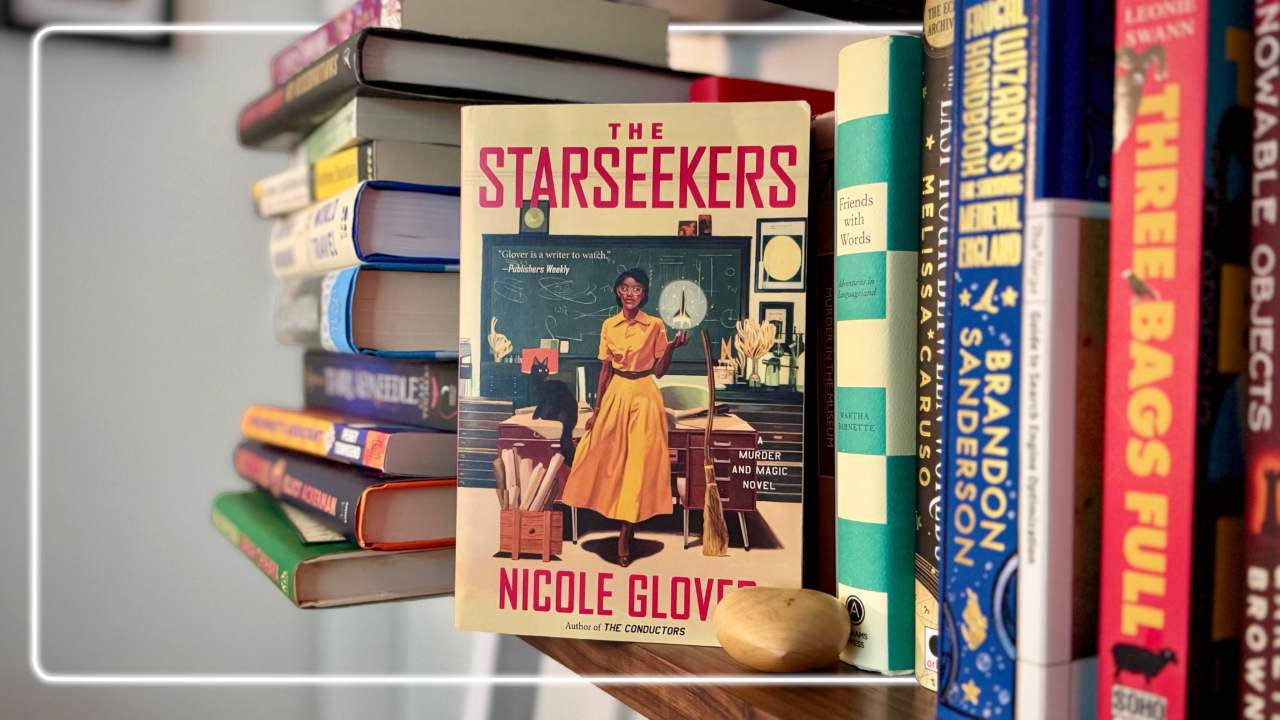
Faithful readers already know I have a huge love of both mystery and fantasy novels. I love reading and writing about these genres, particularly when entries feature complex characters and social settings to match. What might be less familiar are my STEM roots. My father is a professor in the department of engineering; my mother, a psychiatrist. They raised a daughter with a fascination for the natural sciences and those who work with them.
Which meant the minute I learned about The Starseekers, I knew I had to read it. The book takes place in 1964, following a magical engineer as she works on a rocket, hosts a local educational show, and solves a local murder or two. Magic, murder, math, and mystery? Count me in. (Thanks to NetGalley and Harper Voyager for the review copy.)
When you’re looking at a cross-genre novel like this, I feel it’s important to assess each of the component parts. The Starseekers wants to establish a fantasy setting, a murder-mystery plot, with a Lessons in Chemistry-style protagonist. It’s a lot to manage – how well does it all hold together?
Fantasy and the limits of worldbuilding
We’ll start with the fantasy setting. It’s been a while since I’ve spent time in Nicole Glover’s Murder and Magic world. The magic system remains consistent, based on astrology and star signs, but it has come out of hiding. Magical people of color now practice openly, and public broadcast shows even demonstrate how to use this power.
That doesn’t mean discrimination has disappeared—far from it. As you might expect in a series so steeped in race, Glover establishes a divide between more traditional practitioners and wand-users, with a clear hierarchy between the two. Some of Cynthia’s friends are reluctantly learning to use the new tools for their work and daily lives. At school, her sisters are effectively barred from meaningful magical education when they are forced to channel their powers through wands and wands alone.
The implication—that racism has evolved into new, subtler methods of exclusion—is clear. However, Glover also wants to have her cake and eat it too, and the result is somewhat muddled. Without getting into spoilers, it’s evident that NASA relies on traditional magical methods and is even willing to fund research into them. As a result, the usual “story” of American racism doesn’t map cleanly onto this world: Black people here are recognized for technical value and expertise, not merely physical labor.
Murder and Magic has always featured what Glover calls “everyday” magic. While the core system relies on astrology, there are other, less clearly defined magics as well. Magic can be infused into cooking or potions, sent through paintings, or worked into metal and gadgets. This creates a world full of whimsy—but also one that feels unpredictable. And unpredictability can be a real challenge in a whodunnit…
When everyday magic meets crowded mystery
Which brings us to the mystery itself.
The plot truly kicks off when a man arrives at a TV station injured and bespelled. This catches the protagonists’ attention, and they begin tracing the spellwork. But before much progress can be made, a major accident occurs at NASA—one that Cynthia and Theo suspect may be tied to the same culprit.
If that doesn’t sound complex enough, don’t worry. Over the course of the novel, we also encounter amnesiac grandparents-turned-treasure-hunters, Theo’s tangled relationships within the archaeological community, and the national syndication of Cynthia and Theo’s local television show. Then there are the personal subplots: Cynthia’s sisters’ emerging talents, her friendship with the host of a local cooking show, and her romance with Theo all factor into the narrative.
If this sounds like a lot to keep track of, that’s because it is. Nearly every scene advances two or three subplots at once. While they do eventually converge, I found it difficult to keep all of these threads “active” while reading. Add in a flexible magic system—one without the rules and constraints that make a mystery feel solvable—and the result is a story that feels less like a mystery and more like a magical adventure.
There’s nothing wrong with a magical adventure. But don’t expect to solve this mystery yourself without a notebook for diagrams and a reference manual for constellations and the several magic systems at play.
The book does include reference material in its front matter—unfortunately, it’s a Rhodes family tree, which I rarely found useful. I don’t often want reference material in fantasy novels, but here I would have loved a guide to the constellations and their magical significance, particularly since those associations inform character judgments and key elements of the mystery. The same goes for a clearer breakdown of how the various magic systems intersect and overlap.
It turns out that “everyday” magic, while wonderful for building a cozy fantasy atmosphere, can absolutely undermine an already complex murder mystery.
At its best: History, STEM, and representation
The Starseekers is also a historical novel, and it’s in these elements that the book truly shines.
Inspired by Hidden Figures, the novel features a young Black woman whose mathematical skills make her indispensable across multiple departments, checking everyone’s calculations. She’s also a magical expert, which leads to her hosting an educational magic program on local television. Add in adventurous grandparents and a natural aptitude for solving mysteries, and you get Cynthia Rhodes: Elizabeth Zott with sisters instead of a daughter, magic instead of chemistry, and an actual professional outlet for her STEM talents.
I genuinely enjoyed how many facets of historical reality The Starseekers explores. Glover engages with feminism and racism across STEM, media, and education, portraying both the tensions of these spaces and the genuine joy people found within them. Much like her magic, she’s interested in the in-between moments of history rather than the headline events.
I understand and appreciate that intent. But there’s a tension here between two goals: portraying the joy and success of Black lives in the 1960s, and constructing a cohesive, solvable mystery. Glover successfully establishes the Rhodes family as a supportive, clever, creative community. However, Cynthia and Theo are written as the protagonists, not the collective.
Which would suggest that they should be the primary drivers of the mystery’s solution.
Community vs. protagonists
Without spoiling the ending, I’ll say that the path to the solution does not belong to these two characters alone. That could work beautifully—if readers were more deeply connected to the larger ensemble. Instead, because the novel spends time across so many settings and groups—NASA, the TV station, the school, the college campus, Baltimore as a whole—we never get to know most of these people particularly well.
As a result, it’s difficult to feel invested when everyone contributes to the final resolution. In trying to explore so many fascinating aspects of Black life in the mid-1960s, Glover ends up diluting the impact of any single one.
(And I’ll add this in parentheses, because I may be mistaken: I found it notable that the novel largely fails to acknowledge the broader American Civil Rights Movement unfolding at the time. Perhaps in this world it isn’t necessary. Perhaps the Rhodes family simply isn’t involved. Or perhaps the wand-versus-traditional-magic divide is meant as a proxy. But since race remains a distinct and explicit theme in the series, that substitution doesn’t entirely work for me. If you’ve read this and have thoughts, I’d genuinely love to hear them.)
Reader’s rating and review (⭐️ ⭐️ ⭐️ )
I was so, so excited for The Starseekers when I first heard about it. Magic, murder, and the moon—what could be better?
And while I enjoyed my time with the book, I couldn’t help wishing that Glover had been a bit more focused and deliberate, both in her worldbuilding and her mystery construction. Fantasy and mystery can absolutely be warm, cozy, and fun genres—but they also benefit from constraints. It feels as though, in her research, Glover uncovered so many rich historical seams that she struggled to cut any of them.
The result is a fast-paced magical adventure full of community and charm—just not a “true” fair-play magical mystery.
Read this if…
- You like the sound of “Hidden Figures, but magic!”
- You’re intrigued by Black roles in early media, viewed through a fantasy lens
- You like thinking about the “little moments” of Everyday magic
- You like fast-paced adventures with large ensemble casts
Skip this if…
- You want a fair play mystery
- You’re looking for tightly constrained fantasy worldbuilding
- You prefer deep immersion in a small, well-developed cast
The Starseekers is the book that cost me nothing for this year’s 52 Book Club Challenge.
