
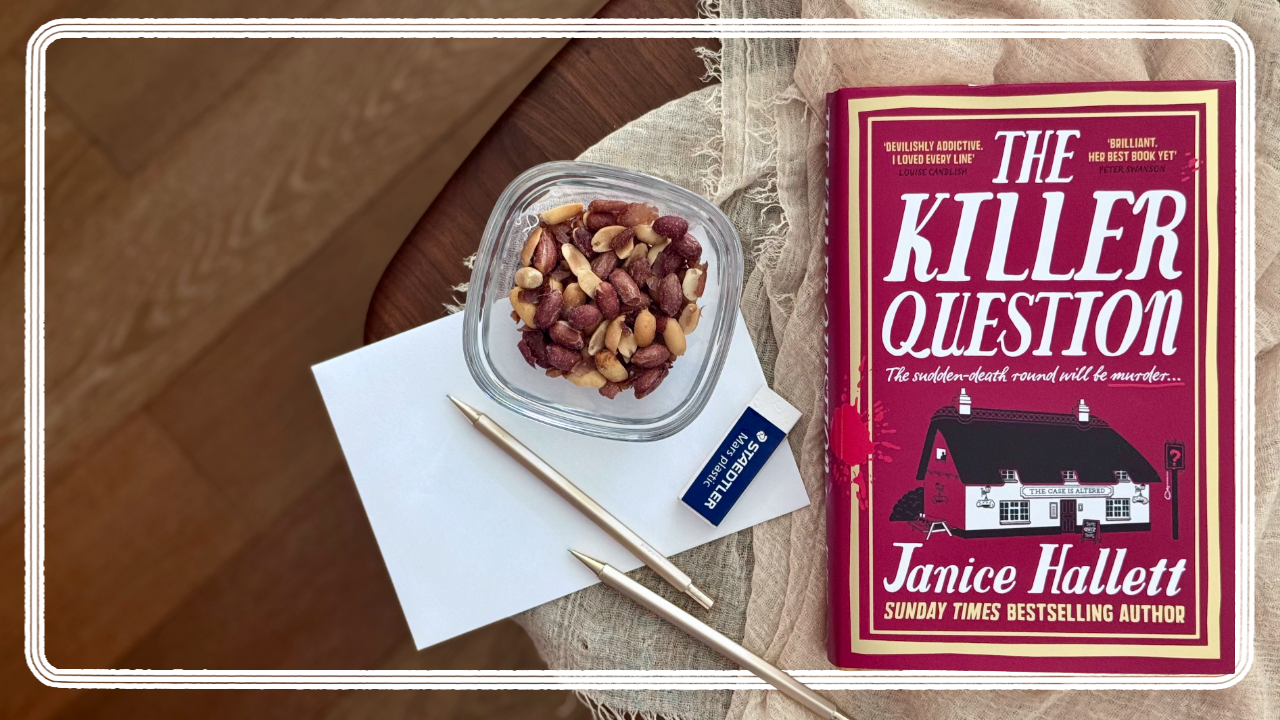
The air is crisp, orange is back in season, cinnamon has started to permeate – mystery season is back. And what better way to celebrate than a new Janice Hallett?
Long-time readers will know that Hallett is one of my favorite modern crime authors. She’s one of the only authors working in epistolaries today, and she consistently comes up with clever new stories and framing devices. Reading her novels is like solving a particular clever escape room – but with extended personality. So you can imagine how excited I’ve been for her latest release, The Killer Question.
The Killer Question follows a pair of pub landlords, Sue and Mal, as they try to grow their business. Sue and Mal, it transpires, have a former life in the police force. It’s the interplay between these two lives that their nephew shares with a TV producer as he pitches a show about their lives. A totally new framing device and a totally new setting. I was thrilled to get access to an early gift copy from Atria Books and NetGalley. And I’m excited to share my thoughts with you!
This review avoids major plot spoilers, but it does discuss the book’s structure, framing device, and general themes. If you prefer to go into a Janice Hallett novel with zero foreknowledge, you might want to bookmark this for later.
The Pub Quiz perspective
The Killer Question bounces between Sue and Mal’s life in their pub and their life in the police force. Like The Twyford Code, the two stories intersect, switching narratives from one to the other. In the pub arc, Sue and Mal have to deal with a mysterious new pub quiz team who somehow gets every answer right, ruining the fun for everyone. In the police arc, they must handle a kidnapping case, supporting the impacting family through the matter.
One thing I enjoy about reading Janice Hallett’s books is how much I learn about life in the UK. The Killer Question is no exception, giving me a deep-dive into pubs, the culture around them, and what it takes to operate one. There’s operations, for one – Sue and Mal text with other landlords, united by their brewery partner. (I hadn’t realized pub “chains” like this were a thing!) Then there are the pub quizzes – Hallett spends a lot of time on the pub’s patrons and their responses to the new, interloping team. She paints a detailed portrait of how different teams operate – how they study, why they participate, how they react to wins (and losses). The pub sections of The Killer Question feel very much like diving into a series of little communities.
That said, while these sections were plenty of fun, I felt like I would have enjoyed them more with just a little more info on the pub quizzes themselves. I assumed going in that the framework was similar to a US trivia night. But pub quizzes, it seems, are to pub trivia night as Guardian Cryptics are to NYT Crosswords. A bit more to puzzle through, a bit less to simply know. At certain points in the book, this led to moments where I could intellectually connect with teams’ frustration at Mal’s tricky questions, without having a real sense of what really tricky questions might entail. (Maybe someone will try to rewrite the pub quiz questions! I’d love to see if they do, so I can get a better sense of what type of tricky we’re talking here.)
A question of framing
The Killer Question also introduces yet another framing device. Here, Sue and Mal’s nephew shares files with a TV producer, in the hopes of creating a documentary about their lives. Hallett, it seems, has grown more interested in how media intersects with crime stories. (The Mysterious Case of the Alperton Angels follows a pair of podcasters as they investigate.)
Unlike Alperton, however, and really all of Hallett’s prior books, The Killer Question takes place entirely post-action, even post-denouement. There’s no active investigation into Sue and Mal; rather, their nephew wants to sell a complete story to someone else. Because he’s not sharing updates on a live investigation, we don’t get the typical stream of disparate investigative threads across different perspectives and times. Instead, the content comes parceled into “show episodes”, organized strategically to reveal the right information at the right time. For a frequent Hallett reader, there’s less of a sense of watching something unfold. Rather, I was constantly aware that certain facts must have been held back, because of the framing device itself. The letters to the producer reinforce this, as the nephew talks about adding to the story threads.
That difference in framing device also changes a bit about the pacing. Because Hallett’s stories frequently feature “live” investigations, there’s often an exciting climax where the past and the present meet. In many of her other works, there’s some kind of fight or explosion or other unexpected event that puts lives in danger and sends help rushing in. If I’m remembering correctly, it’s only in The Appeal where we completely avoid this sort of action sequence – and now, in The Killer Question. For what it’s worth, I think the story is better for it – more focused on the mystery and the puzzle, less on High Drama. (I’ll avoid saying much more here because – spoilers.)
A few words on fair play
It’s been a while since Hallett has written a true “fair play” mystery, and I’m not sure The Killer Question counts. As with many of her works, there are several twists. Some are solvable from the content in the text, while others come totally out of left field. (Hallett continues to play with the fact that she’s in a totally written medium and that you can’t see what she’s writing about. If you’re curious about what I’m talking about and don’t mind spoilers, drop me a line! I’d love a discussion.)
That said, I’ve always been a bit more willing to give epistolaries a pass on this, because they still scratch my puzzle-solving itch. Hallett remains a master of writing consistent arcs across multiple characters and formats. Piecing together all those arcs – the landlords, the quiz goers, and the police arc – serve as enough of a “fair play” puzzle that I’m ok with a few surprises not contained in the documents.
Reader’s rating and review (⭐️ ⭐️ ⭐️✨)
I continue to love Hallett’s writing style, and her puzzles. Her ability to create so many distinct characters across different mediums amazes me every time I read one of her books. She uses that skill in The Killer Question to bring pub culture to life, and it’s a perspective I would never otherwise have known. I also appreciate the return to a less action-packed framing story. That said, because I found it hard to connect with the pub quiz sections, I found they went on a little too long for my taste. And I’m not sure I prefer the “packaged” episode format – it makes things a little less puzzly and a little easier to digest, which is not necessarily what I’m looking for. 3.75 stars.
Read this if…
- You’re already a Janice Hallett / epistolary novel fan
- You’re looking forward to diving deep into a small, rural community – or a big-city police investigation
- You’re a pub-quiz aficionado or at all curious about how that culture could (hypothetically) lead to violence
Skip this if…
- You need to fully understand a culture before reading about it, and you don’t know much about pub quizzes
- You’re looking forward to Big Action Scenes à la more recent Hallett novels
- You want every single revelation to be totally and fully clued up
The Killer Question releases in the US on September 23, 2025.
The Killer Question will count as my book read in a ‘-ber’ month for my 52 Book Club Challenge.
