
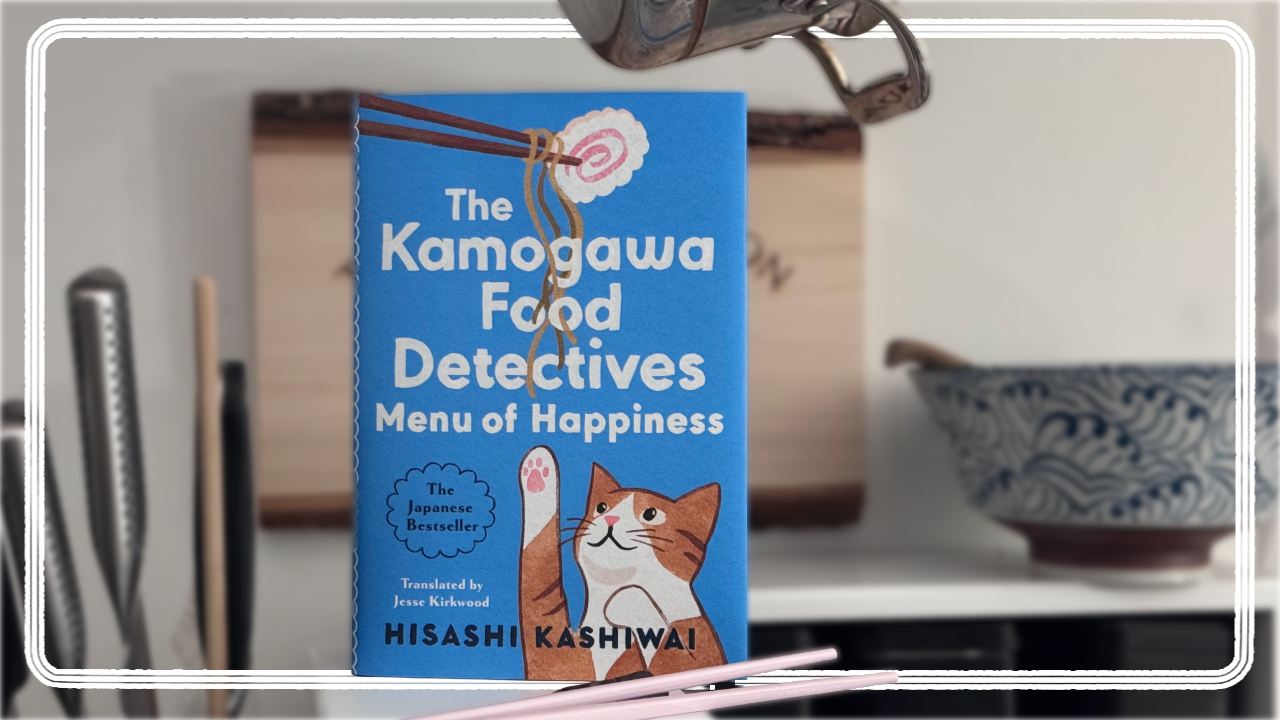
Fall might be the season of warm sweaters and spiced beverages, but it’s also, rightfully, soup season. Between the cooling temperature and the harvest, there’s nothing better than gathering in community over a delicious meal. It’s with this feeling in mind that I cracked open Menu of Happiness, another delicious tour through Japanese food and culture.
Menu of Happiness is the latest in Hisashi Kashiwai’s Kamogawa Food Detectives series. The series follows a father and daughter who run a café with an interesting sideline in investigation. Patrons in the know can request help rediscovering a recipe from their past, usually linked to a heartwarming origin story.
I first discovered this series through an early ARC of The Kamogawa Food Detectives, and I’ve been hooked ever since. So I was very excited to get an early copy of Menu of Happiness to review – thanks to Putnam and NetGalley for the gift!
A tried and true recipe
The formula of The Kamogawa Food Detectives series is simple. Each chapter introduces a new “client”, who’s typically surprised by the nondescript café. Some have found the place via an advertisement; others have been referred by friends. Each has some secret heartache, tied to a lost recipe, that they hope to address.
Before they can unburden themselves, however, they must partake in one of father Nagare’s meals. More on this to come – for now, know that they are prepared by the chef based on his interests, rather than the customers’. Then it’s time for an interview with Koishi, who helps each client break down the particulars of the recipe they’re missing. This requires both culinary and personal particulars, and it’s here we start to understand each client’s journey to the Diner.
When they return two weeks later, Nagare has inevitably cracked the code, traveling far and wide to find the perfect ingredients and preparation methods. As the client savors their perfect recipe, Nagare outlines his investigative process, an impressive combination of culinary and cultural expertise with real human investigation. Clients always leave with more than a recipe, and you get the sense they’re ready to take the Next Step for themselves.
It’s well-worn formula – after twelve installments you might think I’d get bored. Yet I keep coming back to the well, and here’s my current reasoning for why.
A mouthwatering menu…
Every chapter of this series contains two culinary moments: the first meal and the solution. Each meal is described to perfection, and inevitably leaves me searching for a Japanese restaurant to sate my hunger. The two meals, however, serve different purposes, both culinary and literary.
The first meal is a set menu, dictated by Nagare, upon each client’s first visit to the Kamogawa Diner. The meal consists of several small dishes, served together in delightful combinations. (Menu of Happiness adds an alcohol pairing, new for this entry.) Each dish is described quickly but with perfect mouthwatering details, and the writing highlights the creative and complementary combinations of food. Nagare, as written by Kashiwai, delights in local, seasonal ingredients and preparations, and the meal shows off his culinary prowess. It also establishes his control over the interaction to come, as each client simply agrees to trust the chef.
It’s usually this meal that gets me hungry, wishing I could taste every bite as described. I love imagining all the different scents, flavors, and textures as I read – there’s nothing cozier. In Menu of Happiness, Kashiwai celebrates the elevation of mundane dishes and ingredients to new culinary heights. Clients are often surprised by how seemingly simple food are packed with so much subtle flavor. As a bit of a foodie myself, that’s a feeling I love – and one that keeps me coming back to each new chapter with anticipation.
…laced with cultural insight
If the first meal is about establishing roles, the second meal is all about focus and expertise. Where the first meal lets Nagare play creatively, the second meal hones in on the client’s request. In these sections, Nagare focuses in on the client’s requested meal. The client (and the reader, vicariously) finally gets to taste the meal of their dreams, presented as close to the original as possible. Nagare unveils his detective work in parallel, detailing how little cultural or flavor clues led to the recipe. Kashiwai’s writing here is all about the subtle nuances of culture and cooking, and how the two intersect to create unique flavors.
Nagare’s clients always request some seemingly simple dish that they’re never been able to recreate. Sometimes, they’re just unskilled chefs. But most of the time, the original recipe contained some kind of special modifications, based on the cook’s own cultural background or local ingredients. To figure it out precisely, Nagare must travel to tiny towns all over Japan, interviewing other chefs and sampling local delicacies. His descriptions of these journeys highlights the micro cultures of each town and region. And as a reader, it makes me feel like I’m traveling with him.
It’s not just the culinary component of culture that I enjoy in this series. The detective agency’s clients vary widely, from the middle-class to the rich and powerful. As each describes their life and their concerns, I feel like I’m learning more about how Japanese life operates. Ditto for Nagare’s descriptions of his investigations, as we learn who he talks to and why they respond to him. It’s the best version of couch tourism.
Reader’s rating and review (⭐️ ⭐️ ⭐️ ⭐️)
Menu of Happiness serves up another comforting course in the Kamogawa Food Detectives series — rich with nostalgic recipes, tender stories, and mouthwatering meals. While the mystery element is less a logic puzzle and more a gentle unraveling of memory and culture, some readers might wish for more active clues or interactivity. I, at least, have no idea how well it plays out as a fair play mystery – whether someone with sufficient knowledge of Japanese cuisine could have guessed any of Nagare’s deductions.
But that doesn’t matter to my enjoyment of these cozy culinary tales, full of warmth and growth. A perfect cozy read for food lovers and armchair travelers alike. Four stars – if you think you’ll like it, you definitely will.
Read this if…
- You’re already a Kamogawa Food Detectives fan
- You like to read mouthwatering descriptions of local food
- You appreciate a low-stakes mystery that’s not a murder
Skip this if…
- You’re looking for puzzles that are solvable by non-Japanese audiences
- You prefer long mystery stories to several short entries
- You’re skeptical of mysteries solved via culinary expertise
