
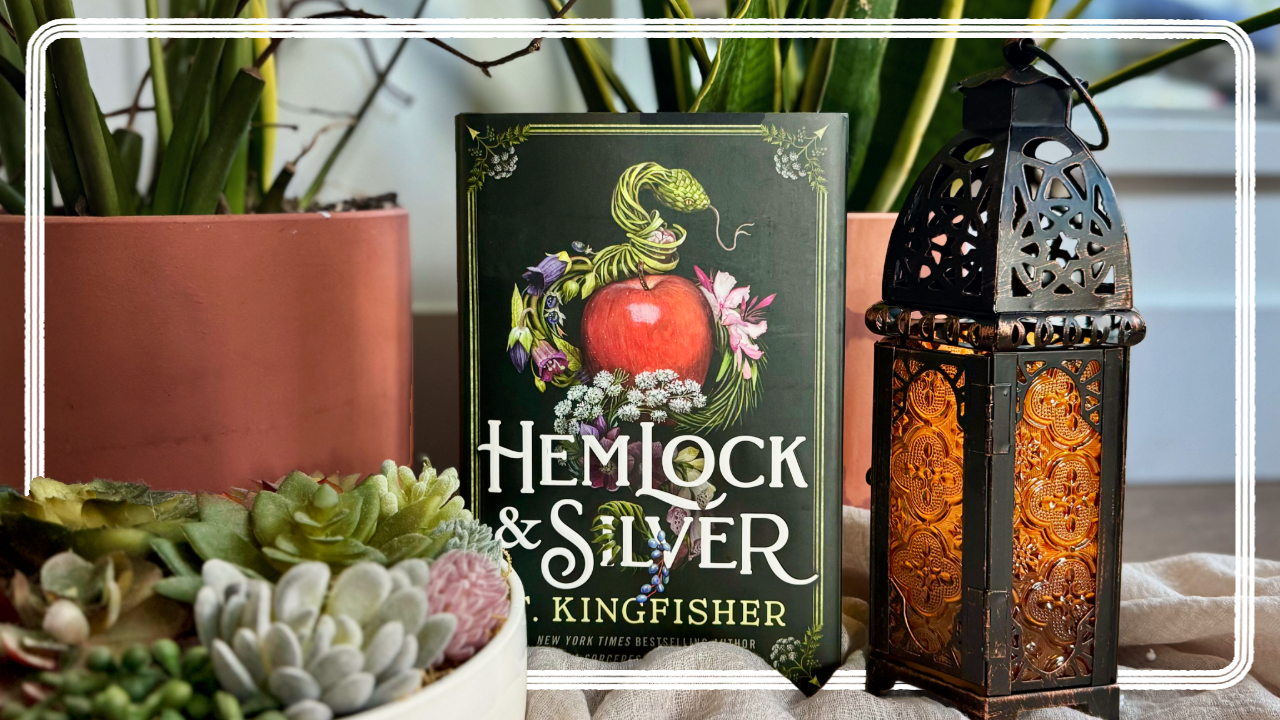
As summer turns early fall, it’s time to start putting aside the beachy reads in favor of cozier aesthetics. It’s early for true dark academia vibes – I don’t need roaring fireplaces just yet; but I also want something a little more thoughtful and grounded. I’m hoping that T. Kingfisher’s recent desert retelling of Snow White, Hemlock and Silver, will meet the moment.
Fairy-tale retellings are their own art form, and T. Kingfisher is one of its most prominent modern voices. The best retellings start with a love for the original—and a sharp eye for its gaps. But they also find holes in the story, asking, “why would someone do this strange thing?” “Why was Cinderella so compliant?” “Why is Beauty called such a reductive name?” “Why doesn’t anyone try subverting Sleeping Beauty’s curse?” And while filling those holes and expanding their worlds to match, they breathe new life into enduring stories, adding new twists to old texts. (Plus, they add a little more fun and action to stories that sometimes rob their protagonists of agency.)
It’s a lot to do in the space of one book, but I was hopeful that Kingfisher could manage. And so I was delighted to get an advance copy to mull over… (Thanks to Tor and NetGalley for the gift!)
Snow White-inspired
Hemlock and Silver is Kingfisher’s take on Snow White, and she takes pains to make it recognizable. There’s a princess named Snow (with a fun reference to her sister, Rose). She has skin that’s pale. She eats an apple that makes her ill. Mirrors are implicated, as is magic. There’s (eventually) a witchy step-mother.
But almost everything else is different, from the characters to the setting. T. Kingfisher often chooses to center a non-protagonist from the original story; her _Goose Girl_retelling, for example, focuses on the “king”’s sister, Hester. Here, she focuses on Anja, a healer the king tasks with saving Snow from a presumptive poisoning. Snow herself is a young girl, focused on entering the mirror world to right a wrong. Her story is mostly one of adult manipulation rather than true personal growth. She’s more than just a plot device—but not quite a fully realized protagonist.
By centering Anja, Kingfisher allows us to see more of her world and its society. Anja herself is a thirty-five year old spinster – an expert in poisons, large and unfeminine and pragmatic. She lives in a desert nation (intriguing for a Snow White story) and wears brown clothes to hide the dust. She’s reluctant to help the king (and concerned about what happens if something goes wrong), which keeps the story grounded to a point. However, as soon as she enters the mirror world, that grounding falls away, replaced by fantasy worldbuilding.
Like any good fairy tale, that fantasy world is more experienced than explained. There’s little explanation for why it exists, and even less of any rules there. Anja learns the barest-bones of the world from a convenient talking cat. Her scientific mind allows her to explore and learn more before she runs into too much trouble – i.e. before she meets the Evil Queen. (Note that this happens a bit later than I expected – it takes over a third of the book to get to Fairy Tale Happenings.)
I won’t rehash the whole Snow White story, but Queens are discovered and defeated. Snow has a little more agency in the whole affair, but requires much assistance to get the job done. And it does end in a Happily Ever After…
Themes, through a glass darkly
Thematically, however, Hemlock and Silver diverges quite a ways from the fairy tale it adopts. The original Snow White is a tale of vanity, of resentment, and of friendship. Snow’s step-mother worries about the daughter who will inevitably eclipse her; the tale is a warning of letting that emotion run rampant. And Snow survives through the love of her friends, who continuously rescue her from several murder attempts. The original Snow is not the sharpest tool in the shed (the Queen tricks her several times), but her perseverance and kindness redeem her. (Modern audiences may rue Snow’s lack of agency – but in reality, she’s got resourcefulness that’s appropriate for her ability to actually fight danger.)
Kingfisher’s story, with its dual protagonists, switches up these themes. We can start with Snow, whose story is (somehow) even more thematically depressing. Kingfisher’s Snow is a young girl, manipulated by the adults around her. While this provides an in-universe explanation for various questionable choices, it also paints a dark portrait of the value of agency. Kingfisher’s Snow is systematically isolated, doomed to a life of magical servitude, but for a timely outsider’s intervention.
Kingfisher’s Queen is much more power-hungry, and much less envious, than the original. Without getting too deep, this Queen wants to take over, and uses Snow and mirror magic in pursuit of those ends. Instead of using her magic to pursue and destroy a single family member, she has fighting forces and works to amass power. Snow’s story is that of an invading force, not a familial dispute.
Then there are the themes in Anja’s story. While Anja learns a little bit about the Power of Friendship, mostly her tale valorizes cleverness and independence. Anja doesn’t fit the mold—an unmarried, middle-aged poison expert more interested in science than society. She uses her curiousity and scientific mind to discover and engage with magic; it’s her knowledge and quick thinking that help her save Snow.
Reader’s rating and review (⭐️ ⭐️ ⭐️✨)
Hemlock and Silver is an engaging modern fairy tale – but a limited retelling of Snow White. Kingfisher treats the original material as aesthetic and story-beat inspiration. This is really the story of Anja the Healer, as she intersects with a particularly important poisoning victim. The result is an engaging and intriguing fantasy world with a great balance between the everyday and the ethereal. (With a little romance and action thrown in for summer blockbuster vibes!)
I’m happy to recommend this for anyone looking for that fairy-tale aesthetic. If you’re looking for a story that has Something to Say about Snow, the Queen, and the society that created them, you’ll have to look elsewhere. As a fantasy fairy tale read, four stars; as a fairy tale adaption, three.
Read this if…
- You’re drawn to vibes and aesthetic reimaginings over strict retellings
- You love inventive worldbuilding and the thought of “mirror magic” intrigues you
- You enjoy pragmatic, middle-aged heroines with scientific minds
Skip this if…
- You dislike ambiguous world mechanics or dark fairy-tale twists
- You want a character-driven retelling that centers Snow White
- You prefer faithful or traditional adaptations
