
We interrupt your regularly scheduled travel/reading posts to bring you a staycation-themed travel post.
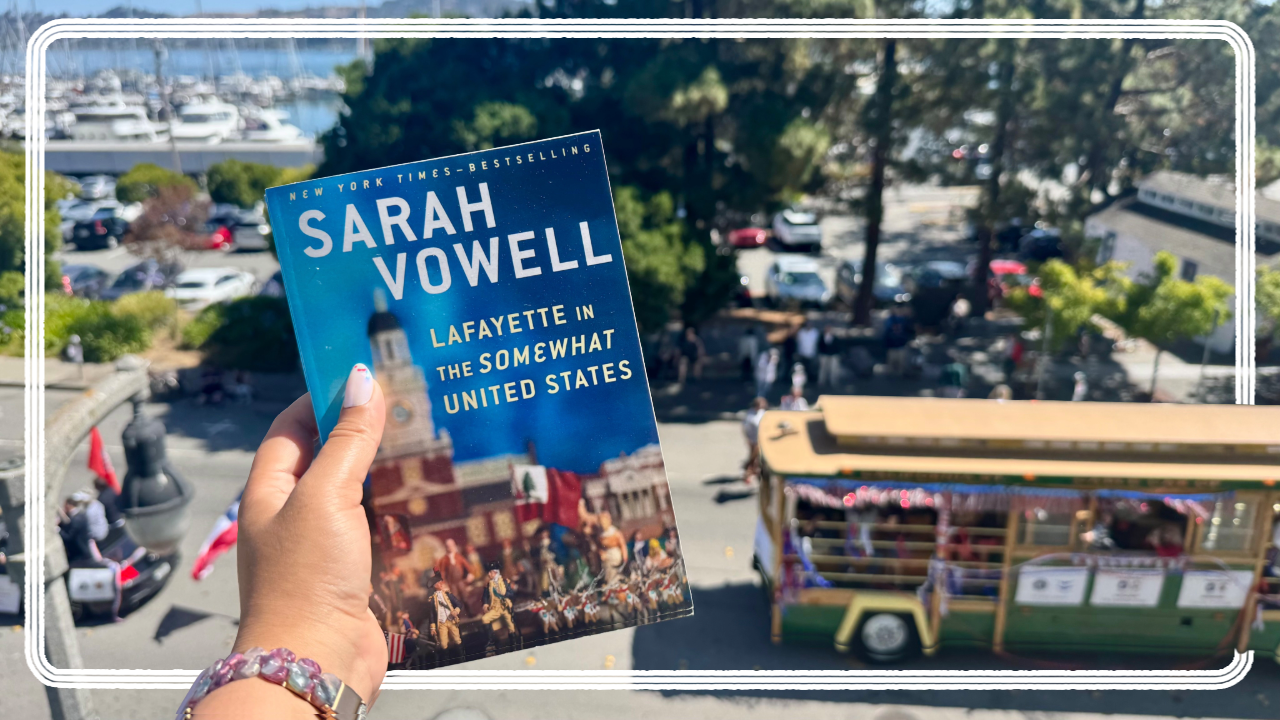
Despite just returning from two weeks in Italy, we decided to up our Independence Day ante by visiting Sausalito’s celebration. Hoping for actually visible fireworks and a small-town atmosphere, we trekked across the Golden Gate for a two-day getaway by the water. And, inspired by my recent non-fiction binge, I decided to read some Revolutionary History while there. (Of course, this wasn’t in Sausalito – but I figure the event relevance counts.)
US history is a well-trodden subject, and it took a while for me to narrow on a book. I landed on Sarah Vowell’s Lafayette in the Somewhat United States, both for Vowell’s humor and her choice of subject. I know even less about Lafayette than other Revolutionaries, and a whole book about him piqued my interest. And I was curious to see whether re-reading the history as an adult would make the holiday feel more meaningful.
Small-town celebrations
But first – Independence Day in Sausalito! The town’s festivities almost perfectly lived up to our expectations. The day started with a cute parade featuring local government officials and performing groups. This was all I expected and hoped for – handmade floats by townspeople who cared, everyone seemingly delighted to participate. The parade was a great reflection of the diversity of even a small coastal town in America, featuring a step troupe and a martial arts group and several senior groups. And I appreciated how local services – the sustainability commission, emergency services – were both celebrated and advertised as part of the community.
We then moved on to an all-town picnic, with hot dogs and giant watermelon slices and tug of war and egg toss. All were welcome, and we had a lovely time lounging in the sun and catching up with friends. Later in the day, we wandered into an adorable bookstore with a unique curation of mystery stories. It was clear the proprietors thought carefully about their stock – what they chose to endorse, how their store expressed their view.
Then came what was meant to be the highlight of the day – an evening picnic event, complete with local fireworks. Alas, the fireworks were not to be. 2025 seems to have been a cursed year for Bay Area fireworks, and the Sausalito fireworks boat took on water before it could reach the designated firing zone. And yet – we made a joyful evening of it, chatting with friends and playing games and watching San Francisco’s fireworks from across the Bay.
All in all, a celebration of America at its finest. The parade, an encapsulation of how freedom of speech, democracy, and diversity build communities. The picnic, a celebration of participation and inclusion. And the unfortunate fireworks show – a reminder that the right people can transform a lackluster starting point. (Apt, perhaps, given the current legislative climate.)
From present to past
All of these themes resonated with my reading. Lafayette in the Somewhat United States tells the story of the American Revolution by following Lafayette through it. Despite his French heritage, Lafayette was best when on American soil – as though he could live up to the ideals it required of him. Vowell also uses Lafayette’s French identity to explore what differentiated the American and French Revolutions.
As in other books, Vowell uses visits to key locations in Lafayette’s history as a loose narrative device. This allows her to jump between her present (2016) and Revolutionary-era history. It was fascinating to see how Vowell connected the past and the present (and to reflect on how much the world has changed in 9 years.)
Vowell uses Lafayette’s story to highlight several founding tenets of the United States. There’s the power of persistence in the face of challenge and doubt. And here’s the willingness to include those who show up to help. Lafayette was one of several foreign agents who showed up to support the US in its time of need – and in pursuit of military glory. Von Steuben gave us military rigor; Lafayette served as a bridge to the French aristocracy, highlighting the bravest acts of war. He did this even as Washington suffered defeat after defeat, literally changing the course of history with his faith.
Then there’s the difficulty of governing a country by committee, which still faces us today. At that time, Washington struggled to feed and shelter his troops, lacking adequate (or any) funds. This meant shirtless soldiers and (in winter) amputated limbs. Today, watching politicians battle, it’s a reminder that checks and balances have been tough from the our founding…. And yet, we chose to keep them in place, because the alternative (unchecked power) is so much worse.
What made America great
It’s here that Vowell uses Lafayette’s kaleidoscope of identities to tease out what made America so unique. Because while Lafayette is, to us, a Revolutionary War hero, he was also French aristocracy. This put him on the “wrong side” of the French Revolution. Even worse, he exacerbated that revolution by encouraging the French to spend on US reinforcements (driving up the tax burden).
Vowell highlights the factors that made the American experiment unique. A population that was already used to self-governance meant that “all men are created equal” could co-exist with real government. Contrast that with a relatively inexperienced French population, fired up by rhetoric and ideals, but unable to hold a government in place. Lafayette himself tried to maintain a balance during the Revolution, but was forced to flee France once the aristocratic hatred turned on him.
Lafayette, in other words, shone brightest when his talents blended with the diversity of the US. He had unswerving faith, bravery, and political capital at his disposal. In the right context, with the right leaders, that became immensely valuable in establishing a more perfect union. But without the right blend of experience and diversity of experiences, Lafayette’s ideals went to waste.
A reflection on independence
It’s a tense time for our country, and it’s easy to feel cynical. So reading Lafayette in the Somewhat United States was a great reminder of our founding. Not just the effort it took to get us independence, but how amazing it is that America has worked for so long. And reading Vowell’s concerns for America 9 years later was another reminder of how much being American is living in conflict, in tension, and in hope for a more perfect union. In Sausalito, as the fireworks burst overhead, I felt immense gratitude to be free to sit with my friends and enjoy an evening in the country our Fathers built.
Back to Italy next! See you soon – and until then, stay cozy, and stay curious!
