
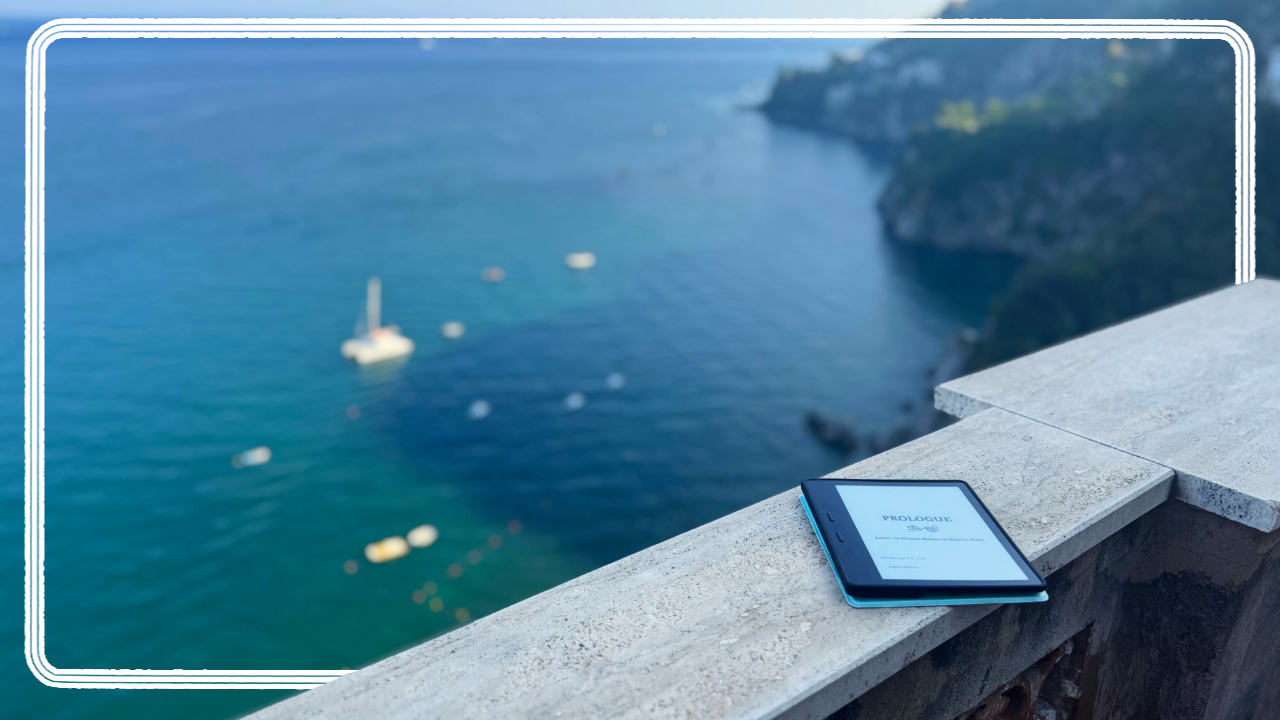
After bidding goodbye to the City of Flowers, we met some friends for a lovely week on the Amalfi Coast – known for lemons, linens, and beautiful ceramic tiles. The sheer cliffs and clear blue waters were a welcome respite from the inland heat. And I was looking forward to a week of lazing around and learning even more about Italy.
But first – I had to find something to read! There are surprisingly few books written about the coast, and my first search led me to a few cozy mysteries. I was determined to keep up my nonfiction streak, however, and I settled on The Land Where Lemons Grow by Helena Attlee. Fitting for a trip to a coastline famed for its giant lemons…
Oranges and lemons

The Land Where Lemons Grow covers a lot more than just lemons – or Amalfi, for that matter. Attlee takes the reader on a tour of Italian citrus, starting with the Medici’s Florentine gardens, through Amalfi and Sicilian lemons, up to the north for chinotto and orange-throwing, and back down to the Mezzogiorno for bergamot and citrons. Of course I’d heard of Sicilian lemons, but I hadn’t realized the true diversity of Italian citrus.
Atlee is clearly an expert on citrus, and pursued this history for years. She layers the history of the fruit across several chapters while bringing citrus farms and flavors to life. As I read further, I was better able to appreciate the intricacies of the coastline. Previously anonymous terraces became rich lemon groves; the towers that dotted the coastline became routes for Moorish defense – and citrus entry. I wasn’t expecting to learn about the Mafia – but apparently Cosa Nostra started with lemon irrigation in Sicily.
There were lighter parts of this citrus exploration, particularly in the food components. After eating an incredible spaghetti al limone, I bookmarked Attlee’s citrus pasta recipe to see if I could replicate it. And I had to re-try dark, bitter chinotto after reading about its Ligurian roots – a perfect late afternoon beverage. My final dessert of the trip was a lemon sorbet, which felt particularly satisfying after this read.
But Atlee’s writing covers not just diversity in fruit, but also diversity in traditions. Each region grows citrus differently, from the terra cotta pots of the Medici to the lemon houses of Lake Garda. They appreciate the citrus in different ways too – candying is popular, but in one notable festival, participants pelt tons of oranges at each other. The Land Where Lemons Grow was a reminder of the diversity of Italian traditions and culture, and it made me want to dive into that aspect further.
Italy, today
A quick search led me to pick up The Italians by John Hooper. Hooper served as a news correspondent from Italy for both The Economist and The Guardian. In The Italians, he works to dissect Italian culture from the outside-in, identifying and exploring several dualities across the region.
Because – as I had learned across my two weeks in Italy – there are several areas where Italian culture feels slippery, hard for an outsider to understand. Hooper, having spent much more time in Italy, opened up even more questions. How much political influence does the Vatican have over Italy, despite being a separate state? What creates the fundamental sense of distrust in government incentives? Why are the North and South so different in culture? What’s up the Mafia regulation?
Hooper attempts to answer this broad set of questions with a historical lens, tying Italian culture to fundamental events in the country’s timeline. He argues that the fundamentals of the culture come from the frequent invasions of the region, which led the Papal States to encourage independent comunes. This led to the fundamental differences between North and South, and the hard distinctions between regions. But it also led to culture that prioritizes stability and tradition, leading to a surprising conservativeness.

Hooper mainly focuses on Unification onwards, touching on the roles of Unification, Mussolini, and Berlusconi as primary conduits of culture. The Vatican has a central role in his story, influencing politics but with a surprisingly loose grasp on daily activity. It’s an interesting approach – but my earlier readings on Roman culture suggest, for example, that the roots of Italian family culture could go back to the days of the Republic. The Italians was a wonderful deep-dive into the history and culture beyond the tourist attractions and monuments, to the modern lives of modern Italians. A fitting bookend to a journey that started with breathing life into the ancients.
A dive into fictional waters

Of course, I had to give myself at least one indulgence. Sarah Penner’s The Amalfi Curse was published in April and tells of a tradition of streghe who protect Positano and its waters. The story bounces between the historical timeline, when someone discovers their secret, and the present day, as an intrepid diver and researcher finds herself uncovering their story.
After reading so much nonfiction, The Amalfi Curse was a fun way to experience a story on the coastline. Penner’s descriptions of the sapphire blue waters around the coast felt all the more real when I’d just swum in them. And my time on the water made me appreciate her protagonists’ love of exploring in the clear blue waves off the Positano shore.
Unlike the fiction I’d picked out last year, The Amalfi Curse seems only vaguely rooted in fact or local legend. While there are local legends of the female-only janare witches, their powers are totally distinct from Penner’s streghe. Penner’s maritime details feel well-researched, but the stories themselves are totally fictional. And the modern-day details of diving didn’t feel particularly location-specific. The result being – while I enjoyed the read while zooming around the coastline, it didn’t feel as enriching as other fiction I’ve read on my travels. Just a fun beach read – and sometimes, that’s enough!
A new lens on traveling + reading life
As readers of this blog will know, I rarely read nonfiction. When I do, it’s primarily business or psychology, not history. But I loved reading so much history while exploring locations. And because Italy has so much written about it, I was able to find books that scratched my narrative itch (and used a humorous voice as the sugar) while enriching my travel experience. I’m not convinced such reads will exist for every destination I visit, but this has definitely made me broaden my horizons on great travel reads. I’ll probably try for a more balanced mix of great fiction and non-fiction while traveling (if I can help it).
I apologize for the long hiatus – but I’m expecting that I can return to a more regular posting schedule this summer. See you soon – and until then, stay cozy and stay curious!
The Italians will count for my “has an epigraph” entry for my 52 Book Club challenge this year!
