
After a cozy weekend spent in small-town America, it was time for a full 180. You can’t get much more “big city” than the Big Apple! Bright, loud, and full of life, there’s someplace to go and someone to see in every visit I make. But between the dinners and the cozy hangouts, I made some space for mysteries, cons, and some philosophizing about categories.
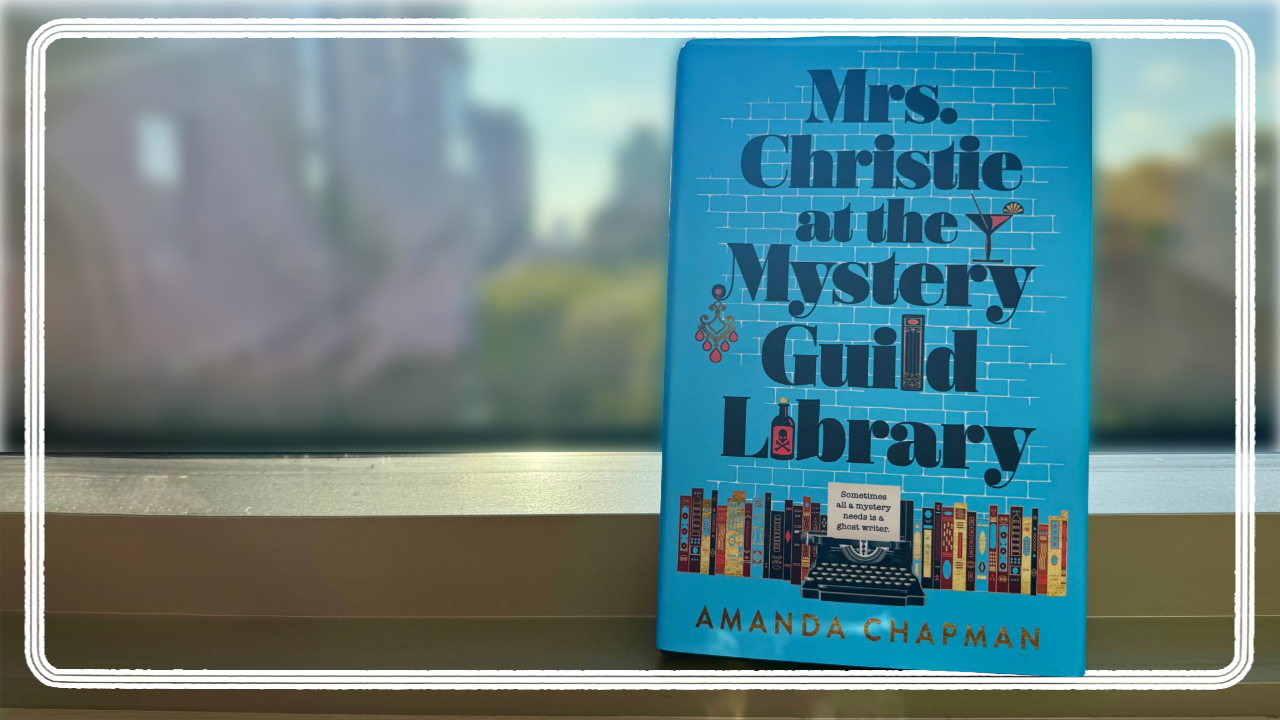
I went into the trip hoping to do a TON of NY reading, but I only made it through one book. This recent release, Mrs. Christie at the Mystery Guild Library, features Dame Agatha’s ghost in an NYC replica of her library at Greenway. I scrapped the rest of my reading plans in-favor of a day-of decision to watch Operation Mincemeat, a five-person musical comedy about the time the British used a dead body to leak fake invasion plans in WWII. (Because when my brother tells me to watch a play, I watch it.)
This week got me thinking a lot about categories. What makes something a city book, instead of just being set in a city? When does a government con become a crime story? What are these genre lines doing for us as readers — and when do they just get in the way?
A story with NY assumptions
We’ll start with the book, Mrs. Christie at the Mystery Guild Library. Mrs. Christie is a cozy paranormal mystery, in which a wealthy NYC book conservator gets help from the ghost of Agatha Christie in solving a series of murders. Dame Agatha’s ghost retains all her living knowledge of poisons, which is quite convenient for detection purposes. Tory, the protagonist, provides access to a private library that becomes a gathering place for clues, suspects, and drinks. Add a cute detective with terrible suits, a messy cousin with a messier social circle, and a precocious Irish eleven-year-old, and you’ve got a workable mystery with a load of Christie callouts.
So — what about the New York of it all? Did it matter that the setting is NYC?
To my surprise, yes — but mostly in background ways. The city’s unique cultural infrastructure made the story possible, even if it didn’t make it present. For instance: Tory’s status as a recluse after a personal tragedy leads to the very New York solution of inheriting a building with a full-scale replica of Agatha Christie’s Greenway library. This kind of “eccentric wealth as plot device” works in other places — but it feels believable in Manhattan in a way it wouldn’t in Milwaukee. NY’s theater scene also underpins the plot, as the murders revolve around an avant-garde stage production of Beauty and the Beast. And the diverse cast — from Adrian, the cool Black librarian, to Mairead, the Irish kid who stumbles into Tory’s life while walking her dog — makes sense in a walkable, densely packed, culturally rich city.
That said, the novel doesn’t evoke the city in a textured or specific way. There are passing mentions of cafes, bus lines, and a few iconic bookish landmarks. But I didn’t feel the hum of the city in the prose. Tory’s major growth arc is about leaving her house — so the setting stays mostly static. Mrs. Christie might not bring us to the streets of NYC, but it borrows from the cultural context that New York provides — inherited buildings, eccentric wealth, and niche interests. The setting isn’t a character, but it’s still doing quiet work in the background.
Cons, crime, and other conundrums

I was still mulling this over when I walked into a performance of Operation Mincemeat — tickets purchased that day. (Again: only in NYC.) If you’re unfamiliar, Operation Mincemeat was a real WWII operation in which British Intelligence planted a dead body with fake invasion documents and let it wash up on the Spanish coast. I first read about it in one of those WWII “spy compendiums” that I devoured as a kid, usually listed as an example of “lateral thinking.”
So — why turn it into a musical?
I’m still not sure I can answer that question, but I can tell you that the result is excellent. It’s the kind of niche, high-quality, whip-smart storytelling that thrives in a city with enough theatergoers to support something this weird and wonderful. (There are also literal dancing Nazis at the top of Act II, so — be warned, I suppose.)
All through the show, I kept wondering: Does this count as a crime story?
On the one hand, it was literally sanctioned by the government. On the other hand, it was one of a series of cons the British pulled throughout WWII. This is a story that involves corpses, forged papers, a veritable Rube Goldberg machine of links that “had to go right”. It contains many of the elements of the best heist fiction – just on the right side of the law. In this case, it comes down to the telling. In other versions of this story, the narrators focus on the details of how the Brits exacted the con – how they forged the papers, got senior military buy-in, and pulled it off. This musical, though, isn’t interested in how they did it. It’s interested in who they were(ish).
Operation Mincemeat, treats the actual operation as an inciting incident for its characters’ growth. The quirky operation is a Trojan horse to explore how WWII impacted the men and women who supported it. It’s a story about recognizing the unsung and under-recognized, whose efforts still have major impact. The peak of Act I is a love song, “Dear Bill,” that’s ostensibly part of creating the cover — but also a soaring expression of wartime uncertainty and loss. Not a dry eye in the house.
So in the end, I’m not sure I’d call it a crime play. It uses the aesthetics of a caper, but the heart is elsewhere. It’s not about deception — it’s about dedication. And – even though I went in because of the con – this new way of telling an old story reminded me why it’s great to look through new lenses. Stories don’t always fit cleanly into categories – but neither does real life. And while it’s easy to pick up something easy and familiar (more Christie references, please!), it’s great to look at a story you think you know from a new angle and grow a little as a result.
New York – vibes, not vantage points
The more I go to New York, the more convinced I am that the city is a vibe. It’s hard to capture the energy you feel just walking around — everyone in motion, with a story, just slightly in your way. It’s exhilarating and exhausting in equal measure.
Sometimes, I love it. When I’m benefiting from the incredible diversity that allows niche interests to nest and thrive, I’m in awe. (Where else can draw enough people for a play like Operation Mincemeat, or a specialty store like the Mysterious Bookshop? Which is still on the bucket list.) But in other moments, it’s all too much – too many people, too many options, too much sound. New York is a great place to visit, but I love living in my little “pocket city” of San Francisco.
Up next: more travels, but not necessarily those I’ll write about. (If I wrote every time I visited Seattle, this would simply be a PNW blog.) Instead, I’m trying to figure out how to parse through all the exciting reading coming up. (Katabasis! More Kamogawa Food Detectives! 52 Book Club reads I’m surprised to love!) Fall is always a great reading season for me, and I’m looking forward to writing through it.
Until next time – stay cozy, and stay curious!
