
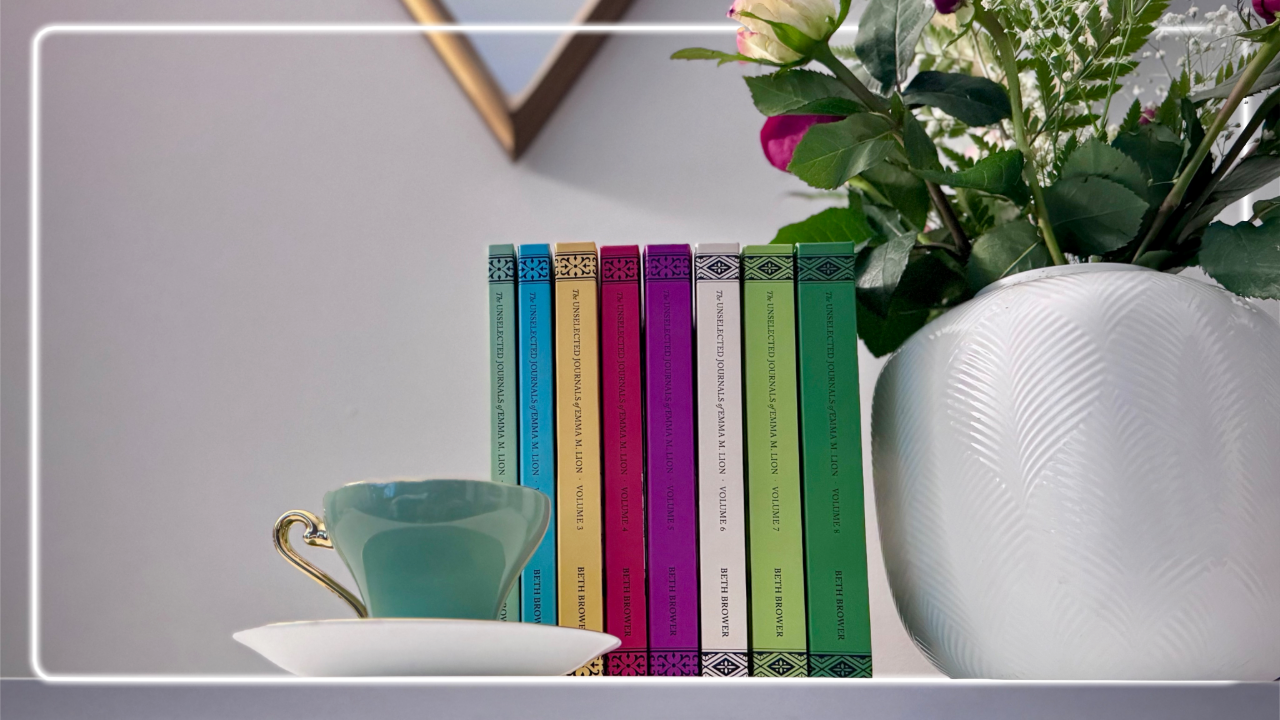
Sometimes, the algorithm gets it right. (She said begrudgingly.)
A few weeks ago, I saw a new book series all over my feed. “The best book series you’ve never heard of!” “The best-kept reading secret!” At first, being a good Snobby Elitist, I paid the recommendations no mind… But as they kept coming across my feed, I noticed that this series was different from the usual reading recommendations I see most often. Most of the series I get are either fantasy or modern literature; this seemed to be Victorian domestic worldbuilding. Most of the time, I see breathless reviews of brooding characters; here, people seemed enamored of the everyday events recounted in the novel. It was different enough to be intriguing…
And thus it was that I fell headfirst into the world of Emma M. Lion.
Enter St. Crispian’s – two months at a time
For those uninitiated, The Unselected Journals of Emma M. Lion is a historical fiction series set in 1883. Our heroine, Emma, moves into Lapis Lazuli House, which she’s set to inherit, and has to make space for herself in the household of an uncle by marriage. Pretty quickly, she realizes she’s in dire social straits: her uncle has frittered away her inheritance; her aunt Eugenia wants to use her as social leverage for her cousin Arabella’s society debut; and she’s distressingly low on reading material.
Emma’s journals show slices of life in St. Crispian’s. Each of the eight volumes covers two months of her time there, and we get to learn the ins and outs of the neighborhood rhythms. Very few books nowadays have this unhurried pace, stretching two months over hundreds of pages and taking their time with Big Plot Beats. As I’ve described the series to people, I constantly find myself referencing Anne of Green Gables, which had no issue narrating Anne’s small woodland adventures with Diana and Gilbert, making both adventures and adventurers feel more real. Emma M. Lion has the same unhurried pace, with the narrative taking note of the small moments (a house meeting to get a fern, a carpet with an unsightly stain) that so bother us in everyday life.
This pacing also allows us to get to know the St. Crispian’s cast quite well, including “bit players”. There are Emma’s closest friends: Mary, Niall Pierce, the Duke of Islington, and the enigmatic Young Hawkers. There’s her family and old friends, who drag her in and out of society events and engagements. There are various neighborhood proprietors, some of whom take a liking to Emma over the course of the series. Each of these characters gets their own distinct moments with Emma, their own voice and priorities and point of view. And because it’s a slice-of-life book, each can return and develop over time, revealing and reinforcing different elements of their characters.
Emma, unfiltered
The result is a series that really feels like getting to know a new friend. Emma’s writing is conversational and free – as one might expect from a personal journal. Most days, she’s able to narrate her experiences with some level of joy or wry wit.
Emma herself is quite the intriguing character: she often chooses the scandalous, honest route over the more circumspect one; she delights in choosing friends who are reliably unexpected and seems drawn to their hidden depths; she has little issue with confrontation and runs headlong into battles for her own agency. She’s between girlhood and womanhood, and often acts like it – she’s informal with the men in her life and routinely makes life decisions that would have delighted me at age 19 and leave 31-year-old me tearing my hair out. Combined with the active social life expected of a Victorian socialite and her natural curiosity, Emma’s journals are full of laugh-out-loud observations and unexpected scrapes. It’s hard to pinpoint a standout moment – but isn’t that how all your most surprising friends’ stories are?
That’s not to say that Emma’s simply surprising or entertaining; she has emotional depth, as do her friends. There’s the loss of her family, and her somewhat harrowing educational experiences. These pains, she’s able to write about as they come up in her consciousness. The real hurt, then, is the loss of her first love, which she’s been processing for several years, and continues to process over the eight volumes released to date. While I won’t spoil the story here, it’s a sad one, and Emma must repress her grief regularly to make it through the requirements of her everyday life. But she carries that small shard of loss, and recognizes it in the friends who make her core squad in St. Crispian’s.
A ribbon of grief
This ribbon of grief winds through Emma’s narration, often popping up when you least expect it. In this way, it mirrors accurately my experience of my own and my friends’ grief, which pops up sharply and fades until you almost forget it, only to hit again. The journal format particularly brings this aspect of living with grief to life, as Emma’s tone and entry length can change so sharply from one page to the next. It’s an intimate portrait of how quickly a wave of grief can hit and how variable its impacts can be from time to time, as well as how irrational and frustrating it can be to the grieving.
To me, it’s this grief that really distinguishes The Unselected Journals of Emma M. Lion and sets it apart from other epistolary novels. It feels rare for stories today to touch upon grief and recovery. (For those looking for such a work in the crime genre, last year’s Fair Play is an intriguing take.) It’s even rarer to portray someone generally mentally healthy but in grief recovery, who can swing from jovial to dejected in a matter of moments. And to show that progression stretched out, rather than skipping the “normal” moments to concentrate all the pathos, is almost unheard of in most of the fiction I read.
Meet me in St. Crispian’s
I’ve been trying, unsuccessfully, to describe The Unselected Journals of Emma M. Lion to friends for the past two weeks. So here is my final attempt at a concise description: A historical epistolary series following a determined, witty heroine as she battles London society, a dwindling bank account, and her own grief in order to establish a happy, if unconventional life. Alternately: if Anne of Green Gables narrated her own stories, came from a bit more wealth, and had a bit of paranormal magic and a lot more adult male shenanigans sprinkled in.
Emma’s story is not for everyone: it’s told two months at a time, often day by day; she has a tiny bit of the Mary Sue in her, with an almost unbelievably modern relationship with societal mores; there are many moments, particularly when she describes the “ineffable something” of her friendships, that make me want to yell “show, don’t tell me again!”. But for all her faults, I’ve enjoyed my time in Emma’s neighborhood, and I’ll happily return to St. Crispian’s for the next entry… (Apparently, we can expect about two dozen.)
Until next time – stay cozy, and stay curious!
Emma M. Lion will count for “from a series at least 8 books long”, “domestic fiction” and “author’s first and last name start with the same letter” in this year’s 52 Book Club Challenge.

Leave a Reply