
It’s hard to believe it’s already December—yet here we are at the end of the year. Honestly? I’m always excited to dive headfirst into the holiday spirit. My tree is up, the lights are twinkling, and I’m prepping for a weekend of intense cookie-baking.
But before we can plunge into the holiday festivities (yes, you can expect another Advent of Mystery this year—the books keep coming, and I keep reading them, despite my protestations!), I wanted to take a moment to celebrate coziness and community more broadly. And what better way to do that than a little foray into cozy fantasy?
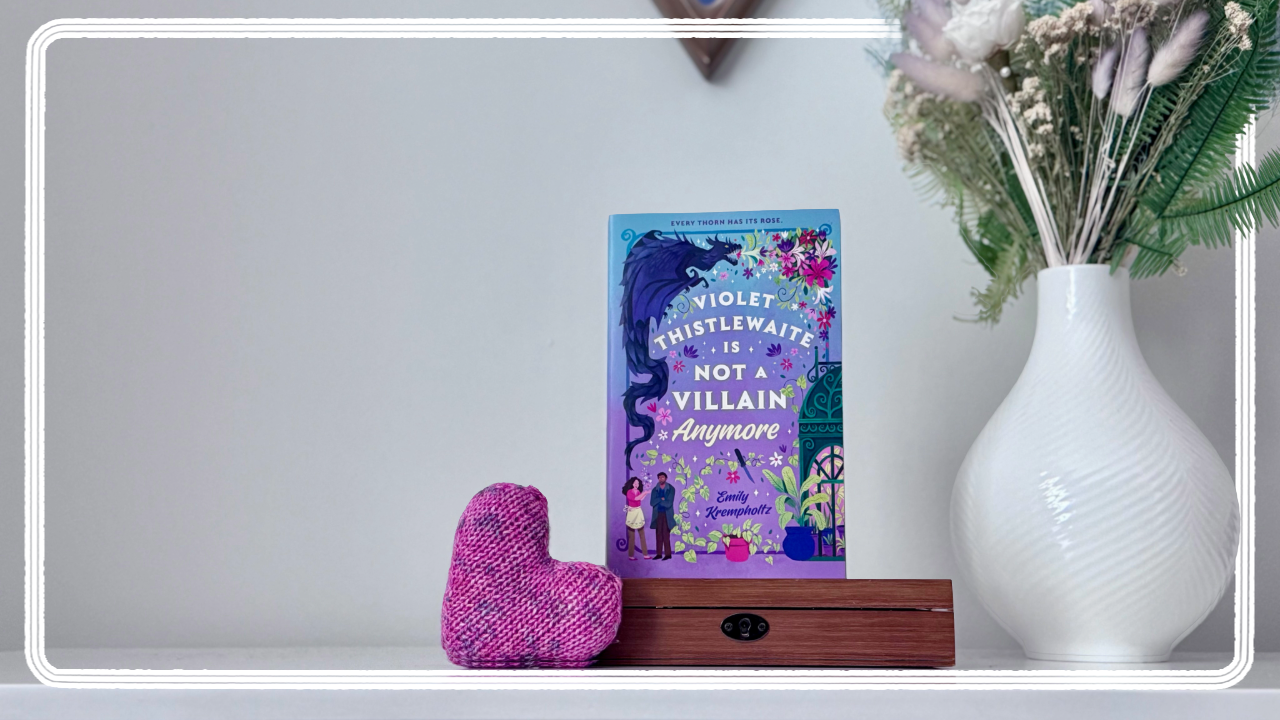
Enter Violet Thistlewaite Is Not a Villain Anymore by Emily Krempholtz. This book contains all the hallmarks of the modern cozy fantasy:
- A heroine with strong powers and a past she’d very much like to escape? Check.
- A sweet little village where she can build a new life? Check.
- A brooding love interest oblivious to his own feelings—and often the world around him? Check, check, check.
The setup is almost prototypical. It could have been predictable to the point of boredom. And while much of the story is predictable, I enjoyed it tremendously. Which raises the question: what is it that makes one of these stories stand out from the rest of the pack?
Mysteries vs. cozy fantasies: the joy of guessing right
Let’s get this out of the way: although I love mysteries, I don’t need every story to keep me guessing. While a good mystery novel thrives on cleverness and (earned) surprise, a good cozy read is all about the relationships, the community, the journey. In a good cozy fantasy, there’s real joy in predicting how things will unfold—and how each character will contribute to the story.
In Violet Thistlewaite, it’s inevitable that Violet will end up with the sullen Nathaniel March. The question becomes: what brings them together? When will he discover her dark secret, and how will he come to terms with it?
It’s equally inevitable that Violet will face her past in some public way, and that her community will support her—probably to her great surprise. So the questions shift: what pushes her to confront it? How will her new community come through for her?
In my opinion, a well-written cozy fantasy rewards the close reader by delivering satisfying character payoffs, not surprising ones. In mysteries, I’m happiest when there’s some kind of interesting yet earned surprise. But in cozy fantasy, that same kind of surprise often feels like an unearned deus ex machina. Instead, I want to understand the characters well enough to guess what they’ll do—how they’ll stand up to the villain, show up for each other, build something together. Because when I can guess it, it feels—if only for a moment—like I’m part of that community too.
And honestly? It’s delightful when the characters are surprised, even if the reader isn’t. It’s a joy to read the dramatic irony of the Brave MC ready to Go It Alone, only to realize she has more friends than she realized. After all, isn’t that a wish all of us would love to see fulfilled in our own lives?
Unique voices, recognizable characters
It’s not an easy balance to strike. Too often, cozy fantasy characters feel like cardboard cutouts—patterns we’ve seen a dozen times. Other times, the novelty is turned up so high it feels gimmicky, overshadowing the plot or the community spirit. (Meg Shaffer sometimes reads this way for me.) Or the magic system is so loosely defined that any solution feels like a deus ex machina. (Beth Durst’s writing occasionally suffers from this, with conveniently vague spellbooks galore.)
So the balance, then, is a character who feels worth getting to know – but who’s also knowable. Somewhat of a trope, but with enough unique and theme-supportive traits to make the reading rewarding. And it’s this balance that (at least for me) Violet Thistlewaite gets right.
Violet is a great example. Her magic is both cozy and dangerous: plants that can nurture or kill. And she must learn to fuel her magic without hate—even though it drains her. It’s a system readers can engage with and use to predict outcomes, and it ties neatly into her emotional arc.
Nathaniel, the Love Interest, follows a similar pattern. His alchemy powers are interesting, balanced by a classic backstory. He refuses to use his magic at the book’s start, and you know he’ll have to confront that block. The question is when, why, and how Violet plays into that. Familiar, yes—but satisfying.
What sets Violet Thistlewaite apart for me is the strength of its supporting cast and community. Violet and Nathaniel are both quite oblivious, but it’s clear there’s something more going on in this little town. There’s a whole cast of familiar characters – grumpy but supportive customers, the friendly community leader, the cheery sister, the cute and mysterious mascot – who hide their own layers. Unpeeling those layers is extremely satisfying. Even better- it’s those layers that establish a unique community for Violet. This is not just a town full of kind folk – it’s one where, by the end, Violet’s place feels defined and real.
A cozy magical community
Ultimately, this is what I’m seeking in modern cozy fantasy: a community I can curl up in for a few hours, a magical home that feels both comforting and compelling. Characters who feel familiar, a world that feels new but coherent, a plot I can play along with. Violet Thistlewaite delivers all that, with a side of humor and a little spice. The perfect way to kick off a season that’s all about building community…
The Advent of Mystery will hit quite soon – I’m very excited about some of the reads this year! But before that, we have a Very Special literary birthday to celebrate… More on that soon.
Until next time – stay cozy, and stay curious!
