
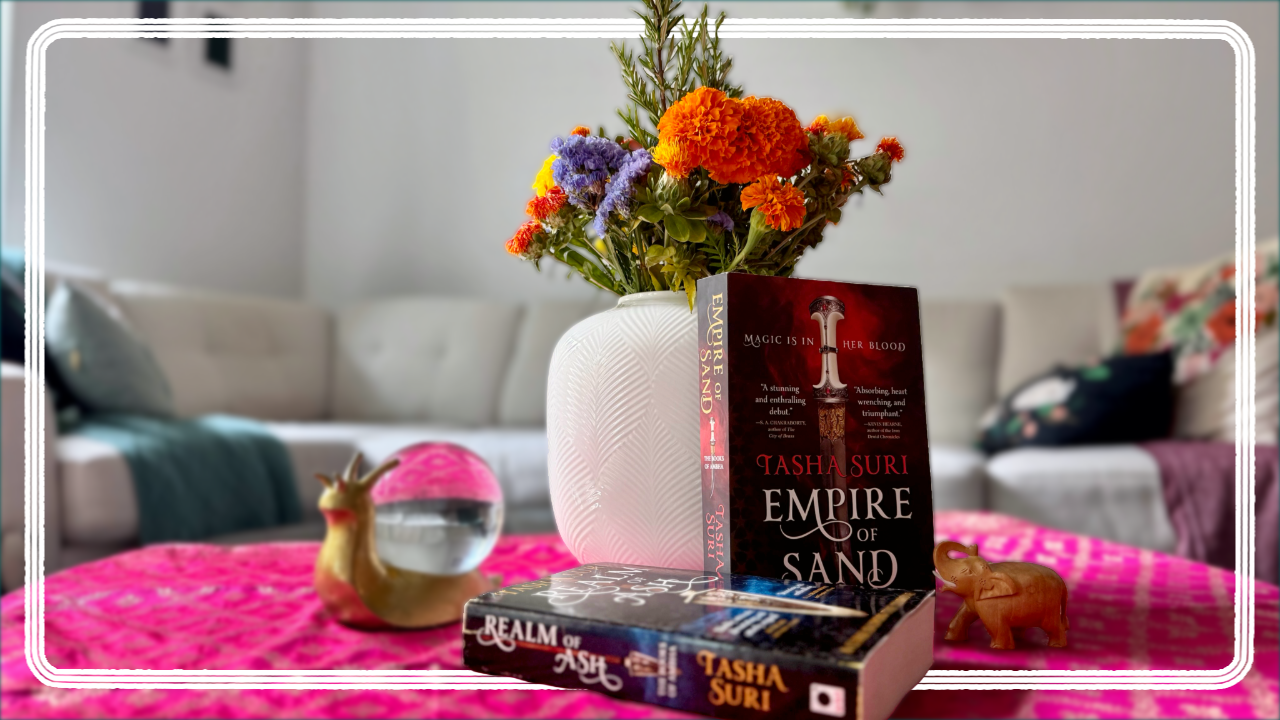
For those who follow my Goodreads, you may have noticed an uptake in my fantasy reading this year. I’ve been really enjoying the epic stories and the intricate human plots – their own kind of mystery. But at times, I can get tired of how so many of the kingdoms are rooted in Western culture and archetypes. As a desi reader, it’s hard not to wish for fantasy that reflects the stories I grew up with.
When I’m in my feelings about desi representation in fantasy, Tasha Suri always hits the spot. I first found Suri’s work with the The Burning Kingdoms series, which featured an ancient Indian setting and an unsettling mythology to match. I loved many aspects of Suri’s writing – her female characters, her lush worldbuilding, her detailed political writing. And so I thought it was high time to give her earlier series, The Books of Ambha, a try.
The Books of Ambha is a duology, set in Mughal-ish India. The story features two sisters, daughters of an imperial governor and an exiled leader of the Amrithi. The novels feature a pretty soft magic system and some harder political plotting. And of course, some romance thrown in for good measure. I devoured the duology this week, and was so impressed by this authorial debut. But I’m glad I came to Suri first through The Burning Kingdoms – and the whole experience had me reflecting on different types of maturity in fantasy writing.
Come for the magic, stay for the politics
I’m actually not much for magic systems, but when I heard about a Mughal-era fantasy, I was intrigued. So much of desi mythology centers the gods, rather than a specific era in history. The Mughals, descended from Mongols, played a unique role in colonizing India… But their empire was also extremely diverse, including Hindus, Muslims, Christians, Jains, and Zoroastrians under Akbar. So I had high hopes for a blend of fantasy traditions, and a rich world to support it.
Politics round one: Mystic edition
Reading the marketing materials for Empire of Sand, one would be forgiven for expecting lots of magical components. The story starts off promisingly enough – two sisters whose “tainted” blood protects them from the daivas; dances that welcome the gods’ dream-rain. But pretty quickly, Mehr gets taken by the dreaded mystics, and finds herself trying to survive in effectively a court.
It’s easy to get swept up in the details of these interpersonal relationships, especially when reading Empire of Sand. There’s Mehr’s arranged husband, a mystic bound by vows that he wants to break. There’s the mysterious and menacing Maha, who forced those vows and seems to control the kingdoms. There are the mystics themselves, rescued by the Maha and loyal to his cause. And there’s Mehr, who’s always pushing for a way to escape the bonds the Maha forces on her.
The result is a book with a LOT of court politics and running in circles, and relatively scant magic. The Amrithi dances feel under-explained, which robs the protagonists of their cleverness when they figure out how to use them. Part of this is because of her choice of protagonist – a daughter divorced from her culture, but sheltered in a governor’s palace. Suri’s writing emphasizes the alienation of those who grew up outside their culture, but can’t share the richness of what they missed.
Politics round two: Take it to the courts!
Realm of Ash suffers from similar worldbuilding challenges. It follows Mehr’s sister, Arwa, all grown up. All her life Arwa has worked to suppress any traces of Amrithi heritage, but a military debacle ends in its discovery. The Ambhan court, it turns out, could use a willing Amrithi volunteer to understand why the Empire is crumbling. So Arwa joins an illegitimate prince in his mission, attending court by day and using magic by night.
As in its prequel, Realm of Ash gets a little lost in its politics. The story bounces between the Ambhan court and Arwa’s exploration in the Realm of Ashes, where she can experience the memories of the dead. Arwa uses this to learn about her Amrithi brethren (and the pain the Empire has visited on them), and to connect with important parts of her culture. But again, because Arwa grew up divorced from her culture, Suri simply picks and chooses the elements of the culture / magic that help advance the story.
The result is a world that feels fleshed out but a magic system that feels flimsy. Despite reading the whole series, there’s a gap in my understanding of both the Amrithi and the Daivas. Besides independence and freedom, I’m not sure what the Amrithi value, nor why their dances call the Gods. It strongly echoes the feeling of growing up in a culture different from your parents’. As an avowed third-culture kid, I can appreciate the metaphor. But the part of me that remains deeply curious about “Mughal magic” is screaming in frustration…
Sisters greater than the sum of their parts
While my fantasy curiosity remains frustrated, my wordlbuilding curiosity was well-satisfied by the duology. Suri cleverly uses the two sisters, Mehr and Arwa, to create a story that’s bigger than the sum of its parts. Because Mehr and Arwa choose such different ways to deal with their heritage, we get to experience a broader spectrum of the Amrithi experience in Ambha.
While she never calls attention to it, Suri’s use of Mehr and Arwa’s differences forces consideration of the broad impacts of colonialism. Mehr represents the rebels – those taken in by the rulers, controlled with violence, forced to tarnish their culture. Arwa represents the collaborators – those who acquiesce before they have a choice, who suppress themselves entirely for inclusion and power. In the gap between them lie their Amrithi brethren, surviving day-to-day in an increasingly hostile Empire. Between the two stories we get a portrait of a culture under siege.
If this reflection seems focused on the two sisters, it’s because the duology centers them. Few of the other characters feel nearly as fleshed out – which is a shame, because several are Amrithi with their own stories to tell. This is most true when Mehr or Arwa have agency; in these moments, they have little room for others’ voice or actions. It’s only when they need support that other cast have room to shine – which is a shame, because several of them are fascinating. Still, Mehr and Arwa are intriguing and compelling, and I’d happily spend more time with either.
Reverse-engineering the story of an author
Reading The Books of Ambha after The Burning Kingdoms felt a bit like tracing the outlines of Tasha Suri’s growth as a writer. So many of her signature strengths are already on display here — rich character work, lush settings, and a soft, thematic approach to magic. You can feel how much care she puts into the emotional weight of her characters’ choices, especially when it comes to identity, power, and survival.
But you can also tell this is an earlier work. The story stays close to its protagonists — sometimes so close that side characters barely get a chance to breathe. And the magic, while atmospheric and full of metaphor, isn’t always grounded in clarity or rules. Compared to The Burning Kingdoms, which lets more characters shape the story and experience the magic in their own ways, The Books of Ambha feels more contained — still powerful, just a little narrower in scope.
Still, it’s fascinating to see where she started. If nothing else, The Books of Ambha is a great reminder that even early in her career, Suri was already writing stories full of thoughtful politics and rich characters. I am excited to see where she goes next…
I am long overdue for a 52 Book Club Challenge roundup, so you can expect that soon. Until then – stay cozy, and stay curious.
