
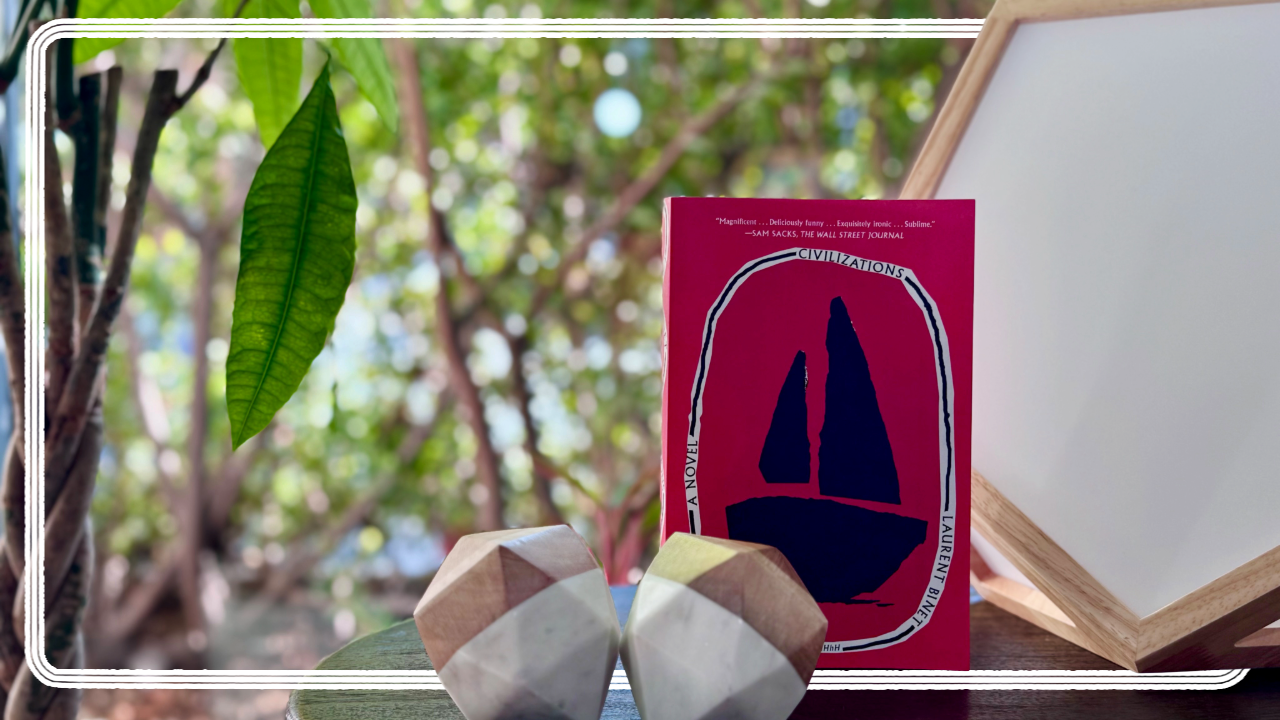
As Thanksgiving approaches, I often start thinking in history. It’s the right time of year to ponder founding stories—of the US and of my own family’s place within it. As my family gathers around the table with a giant turkey, cranberry sauce, and chole, it’s hard not to reflect on the myriad steps that led this group of people to this table at this time. There are so many “what-ifs” scattered through my family’s history, all culminating in the joy of celebrating together each fall.
It’s a similar—though grander—thought process that underpins Laurent Binet’s Civilizations, an alternate-universe history in which the Inca don’t succumb to the conquistadors. Instead, Atahualpa journeys to Europe where, armed with Machiavelli, he proceeds to conquer a large swath of his New World. It’s a heady concept: Guns, Germs, and Steel flipped in reverse. And it’s an interesting way to explore the historical origins of our current civilization—the ultimate “what if it all went very, very differently?”
A historical puzzle…
“Owlet,” you may be wondering, “how on earth did you end up at this alternative history book?” To that, I have two answers. I picked it up because I needed it for my 52 Book Club Challenge (more on that later). But I stayed for the historical puzzle—to predict which elements of history Binet would keep and which he’d twist.
And what a puzzle! I wasn’t joking when I called this a reverse Guns, Germs, and Steel—Binet was inspired by Diamond, and it shows. The first two parts of Civilizations establish the conditions needed for the premise. First, Vikings venture further into the Americas, sharing ironworking and horses with the local populace. They also bring their germs—but over time, the locals develop resistance. Second, Columbus has a very different venture on Hispaniola, critically teaching the locals Spanish.
It’s fun watching Binet fit these pieces together, and it’s even more fun hearing his take on these cultures’ voices. (Columbus, in particular, is satirically annoying to a modern reader.) But this is all a prelude to the main event, where Binet chronicles the life of Atahualpa.
From the very start, Binet centers the Inca. The story opens with an Incan war, and Binet spends time establishing why Atahualpa wants to leave the Americas. When Atahualpa lands in Lisbon, his arrival coincides with an earthquake that grants him easier entry into Europe. From there, it becomes a delicious historical puzzle to see exactly how he will conquer his “New World” with such a small contingent of followers.
As you can imagine, I learned a lot of history reading this. And it put familiar history in a new light. There’s something delightful about remembering that the Inca existed at the same time as Machiavelli and Michelangelo. Reading Civilizations feels like putting together a global puzzle in a way I haven’t experienced since college.
…and an exploration of Empire
Despite what we sometimes tell ourselves, the history of America is a history of empire—of colonization, conquest, and cultural dominance. I’m certainly guilty of compartmentalizing this around Thanksgiving, treating the American story as one of plucky underdogs rather than colonial conquerors. But Civilizations puts that contrast in stark relief. It’s hard to read about Atahualpa establishing an Inca empire in Europe without reflecting on how many similar moments played out in our own timeline, just in reverse.
This is especially effective midway through the story, as Atahualpa begins navigating broader Europe. He takes Charles V hostage in the Alhambra, but remains painfully aware of his tenuous grip on power. And so he and his court play politics—projecting strength while slowly expanding their base. It’s hard not to draw parallels to the fledgling United States: jockeying for global power while scrambling to keep the colonies afloat.
Endings are always tricky for books like this. If they leap too far ahead, they risk losing coherence; if they stay too close to history, they risk underselling their premise. Binet tries to straddle the line, establishing a Mexican empire alongside the Incan one and ending with El Greco and Cervantes captured by these “Old World” empires. And it… kind of works? El Greco’s religious anxieties lost me a bit (I, a Hindu, simply could not follow), but the broader themes landed. Still, the ending felt more like a quiet exhale than the thunderous finale the book seemed poised for.
Giving thanks
Because of that softer ending, I initially gave the book a three-star Goodreads rating. But in the weeks since I’ve read it, I keep returning to it—the story, the voices, the tiny details. Binet has a talent for making the history feel real and specific, grounded in our world even when he deviates wildly from it. I’ve recommended the book to almost every historical fiction reader I know, and several more besides. (It’s currently en route to a Peruvian friend who loves fantasy fiction.)
Civilizations was so far out of my comfort zone, and I’m grateful I picked it up anyway. This kind of expansive reading is exactly why I take on the 52 Book Club Challenge. And it’s why I love having this blog to hold me accountable. While some readers can force themselves to read their vegetables, I am simply not one of them.
So this Thanksgiving, I am grateful for the many “what-ifs” that led me here—this blog and these readers. Thank you to the Internet Gods for giving me a space to think more critically about what I read. Thank you to the life crisis (and partner feedback) that nudged me toward writing these reflections. And thank you for finding me, for reading my esoteric bookish thoughts each week, and for sticking with me as I find my footing in my reading adventures.
We’re almost through November—which means holiday season is fast approaching. Festive mysteries abound soon, of course—but first we need to celebrate one of the greatest authors of all time. (She has a big birthday this year!)
Until next time: stay cozy, stay curious, and thank you, thank you, thank you.
Civilizations will count for my “book that includes Latin American history” for this year’s 52 Book Club Challenge.
