
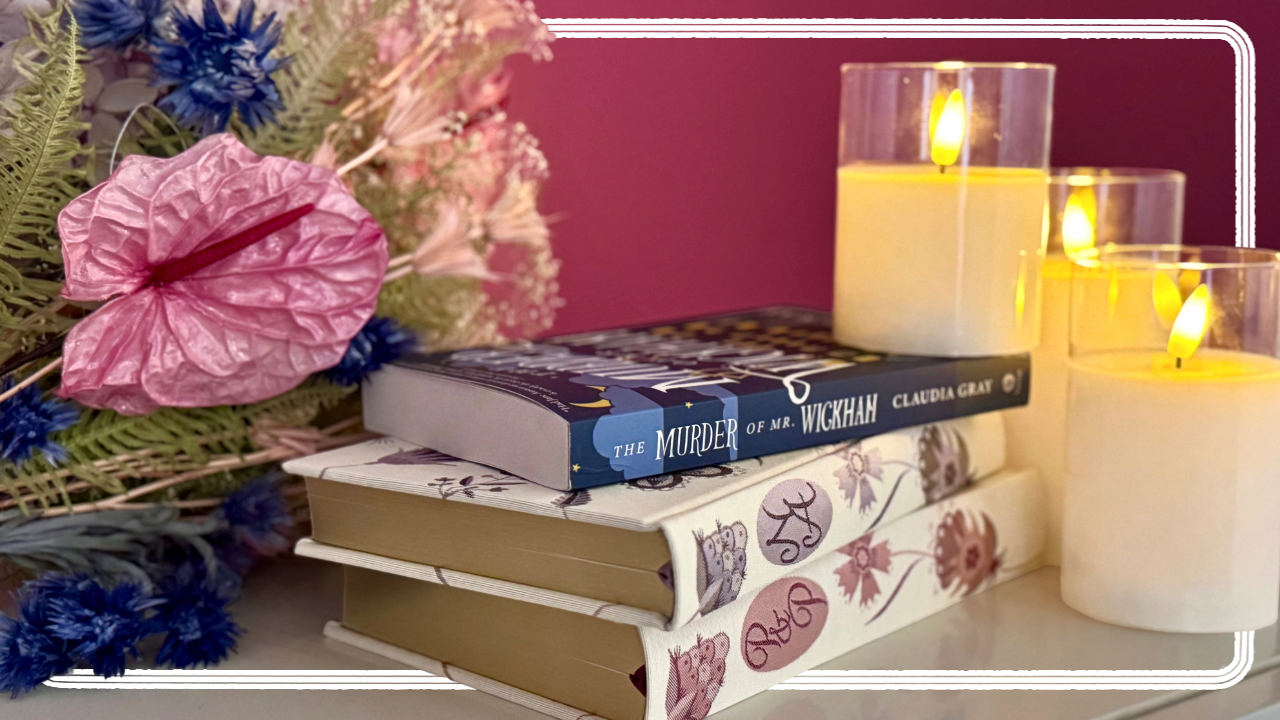
December always feels like a month for traditions—holiday baking, cozy reading, and, this year, something extra special: celebrating Jane Austen’s 250th birthday. With presents piled under my tree and the scent of fresh-baked cookies still hanging in the air, I’m feeling especially inclined to honor the season with a few Austen rereads (and one intriguing re-imagining).
If you’re like me, you’re always looking for some excuse to read Austen. For this Big Event, I landed on a mix of celebratory rereads and new ones. Pride and Prejudice had to make the cut, naturally. For a mystery flavor, I decided to revisit The Murder of Mr. Wickham, which I first enjoyed a few years ago. And since that novel concerns the progeny of both the Darcys and the Tilneys, I finally read Northanger Abbey for the first time. (I know—shocking for a devoted Austen fan, but there was always something comforting about having more Austen left to discover… and now that it’s gone, I’m a bit verklempt.)
Of course, many words have already been written on the two classics. (My short take: I love Eliza, but I fear I am a Darcy. And Northanger is at once a fascinating look at Bath society and a hilarious take on the Gothic novel. Austen’s wit remains sharp and unsurpassed.) So instead I’ll focus on the re-imagining—my reactions now that Austen is fresher in my mind.
When Wickham crashes the party
The Murder of Mr. Wickham is a murder mystery wrapped in an extensive Austen pastiche. The premise: the Knightleys have invited the Who’s Who of Austendom, all at the same time. Elizabeth and Darcy are there, along with their son Jonathan. The Wentworths (a personal favorite), the Brandons, and the Bertrams arrive as well. Rounding out the party is Juliet Tilney, daughter of Catherine and Henry. It’s a full house indeed—made fuller when Mr. Wickham shows up, apparently bearing bad blood with every party present.
Naturally, Austen’s most universally disliked character ends up murdered. And of course it’s up to Jonathan and Juliet to figure out what happened.
For an Austen-plus-mystery fan, it’s a delightful premise. But it’s also a tricky one, because it requires both a solid mystery and thoughtful updates to beloved characters. While this is often a mystery-book blog, today I want to think Austen. So let me dispatch the mystery angle quickly: it’s fine. Imagining Wickham as the Ultimate Villain is hardly a stretch, which makes it easy to give every character a motive. The puzzle is somewhat clued—but it’s not really the point. The draw is seeing where our favorite characters have ended up and how they collide under one roof.
The trouble with pastiche
The first time I read The Murder of Mr. Wickham, I generally enjoyed it. Seeing these characters interact was fun, and the mystery setting was a charming twist. But rereading it so close to fresh readings of two of the main sources made for a very different experience.
Most modern Austen homages have to nail two elements: character and tone. Gray gives herself a third challenge—her next-generation protagonists, who must fit seamlessly into the Regency world. It’s this last part she handles best. The original characters and tone suffer more.
Perhaps this is inevitable. It’s a truth universally acknowledged that a murder mystery in possession of a good hook must be in want of several suspects. Given that Wickham is… Wickham, this means all our favorite characters must harbor secret misery to be plausible suspects. Not only that, the novel must then unearth and resolve each one.
This creates a surprisingly high density of unhappy characters. Yet one of the joys of reading Austen is rooting for these people to get through their trials and emerge stronger. I don’t really want to imagine the Wentworths distant over the years, or the Brandons growing apart. Structurally, this novel bursts every bubble created at the ends of the originals. And while many country-house mysteries feel cozy, it’s less cozy when you’re marinating in your favorite characters’ angst for a few hundred pages.
Tone is another challenge. Gray writes in a modern voice, and her attempts at Austenian wit can feel a bit flat. Austen’s greatest lines often meander toward a surprising twist; it’s a high bar to reach—and one most homages struggle with.
But there’s also a structural tonal issue: Austen’s novels spend chapters in her characters’ thoughts. She reveals them layer by layer. Gray, by contrast, must outline dozens of motives in the same span of pages, which simplifies the emotional complexity dramatically. Ideas that would have taken Austen a chapter or two are handled in a single conversation. There’s little room for the sly satire and keen social observation Austen fans relish.
The very model of a modern murder mystery
All that said, there are bright spots. The brightest are the two protagonists, Jonathan and Juliet.
I love that Gray has characterized Jonathan as autistic. I’ve always related most to Darcy—rigid, awkward, principled—and it’s fun to see how his imagined son navigates the world. Jonathan’s autism lets him see past some of the social constructs that govern Regency life. Austen would never have written a character worried about improperly accusing a servant—Jonathan does.
Juliet is equally delightful. She’s independent and spirited, just as you’d hope, and it’s delicious that Catherine Morland’s daughter arrives at an Abbey only to stumble into a murder investigation. Through Juliet, Gray explores many of the same themes Austen did, especially around women’s roles and expectations.
Gray also weaves in several modern topics. Most notably, she includes a storyline involving homosexuality, treated with a surprising degree of tolerance by the characters. For me, it’s a step too far—especially in a novel already juggling so many reinterpretations. I would have preferred to see Jonathan and Juliet given room to grow within a smaller cast and a more authentically Austenian scope. Instead, we get a modern mystery in Austen attire, packed with incident but unable to evoke the lightness of the originals.
The joy of Jane
Despite my complaints, I have sympathy for Gray. She took on an almost impossible task—cramming the principal cast of all Austen’s major works into one book and giving each a plausible motive for murder. It didn’t quite work, but to her credit, the later books in the series take a simpler approach, focusing on just one or two sets of characters. (Yes, I’ve kept reading them—Jonathan and Juliet remain delightful.)
Rereading Austen, however, reminded me precisely why her writing inspires so much love and homage. Whether she’s in satire mode, yearning mode, or pointed-observation mode, her characters still feel alive 200 years later. Austen is snarky and sardonic where she needs to be, yet she clearly loves her protagonists. She has an unerring eye for the small details and turns of phrase that reveal her characters’ hearts. And her plots feel inevitable in the best way: even when you wish her characters would choose differently, they couldn’t—they’re too true to themselves. Her worlds are filled with deeply imagined humans, their flaws and charms intact, every sentence shaped with care.
I also want to appreciate the beautiful Folio Society editions of Austen’s works that I splurged on earlier this year. Her stories shine in any format, but there’s something luxuriant about reading them in gold-foiled, heirloom editions. The book-dragon part of my soul thrills at turning those thick, beautiful pages—and imagining future generations of Owlets doing the same.
I’ve been teasing it for a while, but Advent of Mystery season is almost here. Stay tuned for holiday mysteries galore… Until next time—stay cozy, and stay curious!
Pride and Prejudice and Northanger Abbey will count for my “book in the public domain” and “book starting with the letter N”, respectively, in this year’s 52 Book Club Challenge.
