
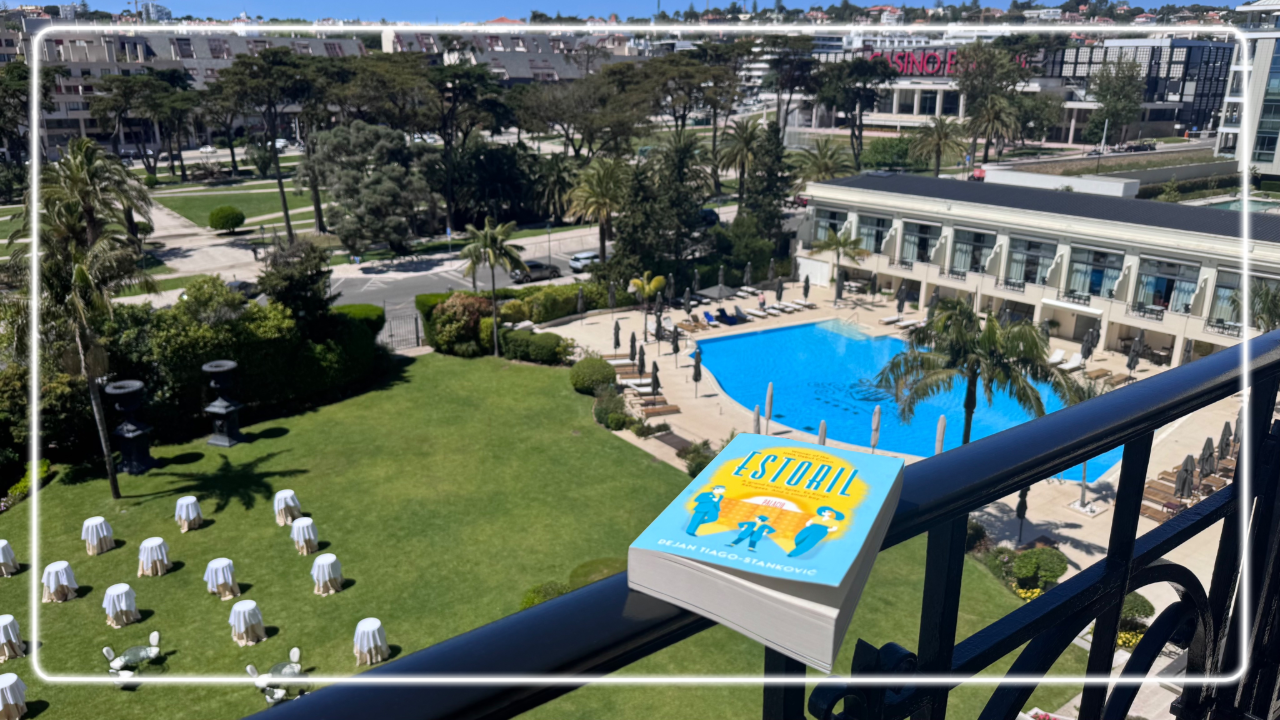
Driving from windy, hilly Lisbon to the sun-drenched streets of Estoril feels like entering a totally different world. Gone are the hundreds of staircases that feel insurmountable after a day of climbing for views; the graffiti that line the walls in a riotous display of free speech. Instead, palm trees and sandy beaches and resort-style hotels beckon.
Underneath that friendly resort façade, however, lie layers of secrets. Because, as I learned while there, Portugal was neutral during WWII. And a sunny resort town in a neutral country attracts all kinds of Important and Interesting people – kings and generals and all their entourages. And where you find Important People, you find controversy – and spies.
Tales of espionage in Estoril’s Palacio
Dejan Tiago-Stankovic lays out a wonderfully fictionalized version of this history in Estoril. Set at the opulent Palácio Estoril, Stankovic starts out with the reminiscences of the hotel’s manager, Mr. Brown, and his introduction to a single guest in particular. From the first time he lays eyes on Gaby, it’s clear he’s an Orthodox Jewish refugee, escaping from the Holocaust. Gaby has the classic curls and plenty of cash and jewels with which to pay for his board. Easy yes, right? Just one problem: Portugal is neutral, and as the landing zone for all sorts of controversial people, Mr. Brown and the hotel are under intense scrutiny lest they seem too partial to one side or another.
After some minor hand-wringing, Mr. Brown opts to let Gaby stay as a guest, and that’s when the real fun begins. Because Gaby is a young boy, it’s relatively easy for him to make friends of all sorts at the Palacio. Through Gaby, we get to learn about the staff (who learn to love him as one of their own) and their ways of working. But we also get to meet a deposed King (who is sorely tempted to adopt the young man) and a Nazi-collaborating chess grand master (who enjoys a few games with the passionate chess player before getting ignominiously assassinated by the USSR). Perhaps most fascinatingly, we get to meet Dusko Popov, codename Tricycle, commonly cited as the inspiration for James Bond.
Estoril bounces between Gaby’s perspective, Mr. Brown’s, and Dusko’s, and each adds a layer of nuance to the wartime story. Through Gaby, we see the humanity of all the dignitaries that come stay at the Palácio, alongside the staff that serve them. (Gaby is equal parts charming and precocious, and thus loved by kings and chauffeurs alike.) Through Mr. Brown, we see the administrative side – the level of government monitoring and intervention required to maintain the Portuguese reputation of neutrality. And through Dusko, we understand the risks and challenges associated with this kind of wartime spying. Combined, the perspectives illuminate the delicate balance the Palácio staff must have maintained throughout the war. It’s not really a perspective on Portugal I’d considered before – what it meant to be a neutral country under dictatorial rule.
Reading history on location
I was also lucky enough to read Estoril while on the grounds of the Palácio itself. And I’m so glad I did, because otherwise I would have appreciated the experience much less. Walking inside, you immediately get a sense of the layers of history in its halls. But, unless you’re paying attention (or look up the hotel online), you’d be hard-pressed to cite it as the hotel that “the real James Bond” frequented. Ditto for the other stories Stankovic covers.
But reading Estoril brought the Palácio to life (and vice versa). Passages about chess games in the lobby or lawn strolls or lunches with erstwhile kings took on new life when I could simply walk to the real locations. And imagining the halls replete with a crowd clamoring to watch the Polish prime minister play piano really emphasized the history in my surroundings. I found that reading the stories directly in the hotel made them “click” much more vividly.


Still, I’ve had that “click” of location before. Newer to me was my ability to share my newfound knowledge with others. It’s particularly fun to be able to tell others the local lore – all the joy of gossip, but with little consequence given the actors are all long-gone. Unlike some of my other, more fantastical travel reads, Estoril had the benefit of relaying real-ish facts which I could verify before sharing with others. And who doesn’t like a good spy story?
I consider myself a reasonably awkward person, and even this little bit of insight helped me make my way through a week’s worth of personal and professional social events. For that confidence alone, I’d say it was worth the price of entry. Once again, I find myself veering away from the more fantastical side of destination fiction, and closer to writing based in reality. It’s a preference I couldn’t have anticipated when I started writing this series – but I’m glad for it, as it’s made me both a more engaged traveler and reader.
Spies, sunlight, and serendipity
Among my reads this trip, Estoril stands out as a specific historical portrait of a hyperlocal destination. Many of my other reads speak to either broader Lisbon (fictional or real) or Portugal more broadly. But reading Estoril allowed me to go deep into a specific place and time – and really bring it to life.
Estoril also represents the continuation of another pattern from earlier reading adventures: a local read, acquired locally. Despite extensive searching, I hadn’t found Estoril by the time I landed in Lisbon. Instead, I stumbled across it while perusing the “Portugal” table at LX Factory’s Libraria Ler Devagar. Because I knew I was headed to Estoril, the cover and title immediately caught my attention.
This level of bookstore serendipity ended up being a feature of this trip. In fact, a surprising highlight of Lisbon was the huge number of bookstores, or livrarias, including the oldest operating bookstore in the world. Of course, I want to spend more time on all my bookstore adventures… So that’s coming up next.
Until then – stay cozy, and stay curious!
