
I’ve spent close to 75% of the last month on the road (I’m writing this from a plane seat!). And while that means I haven’t had the most time to write, it does mean I’ve built up a big stack of readerly thoughts to share with you. There’s content to come on mysteries, and adaptations, and the care and feeding of a reader. But first, and most excitingly – more travel!
About half of my time away from home this month was in Lisbon and its various surroundings. Which, of course, meant, it was time to get out of my reading comfort zone and dive into some local reads. And while it was a little difficult to find reads I felt excited about, once I dove in, I found myself reading something new each day. From epic poetry to fantasy mystery to history, there was a little bit of everything to explore about Portugal. And in so many beautiful bookstores, too! I’m ambitiously feeling capable of writing several posts about this trip – but at this point, also wary of overpromising the content schedule for y’all. So we’ll see how far I get.
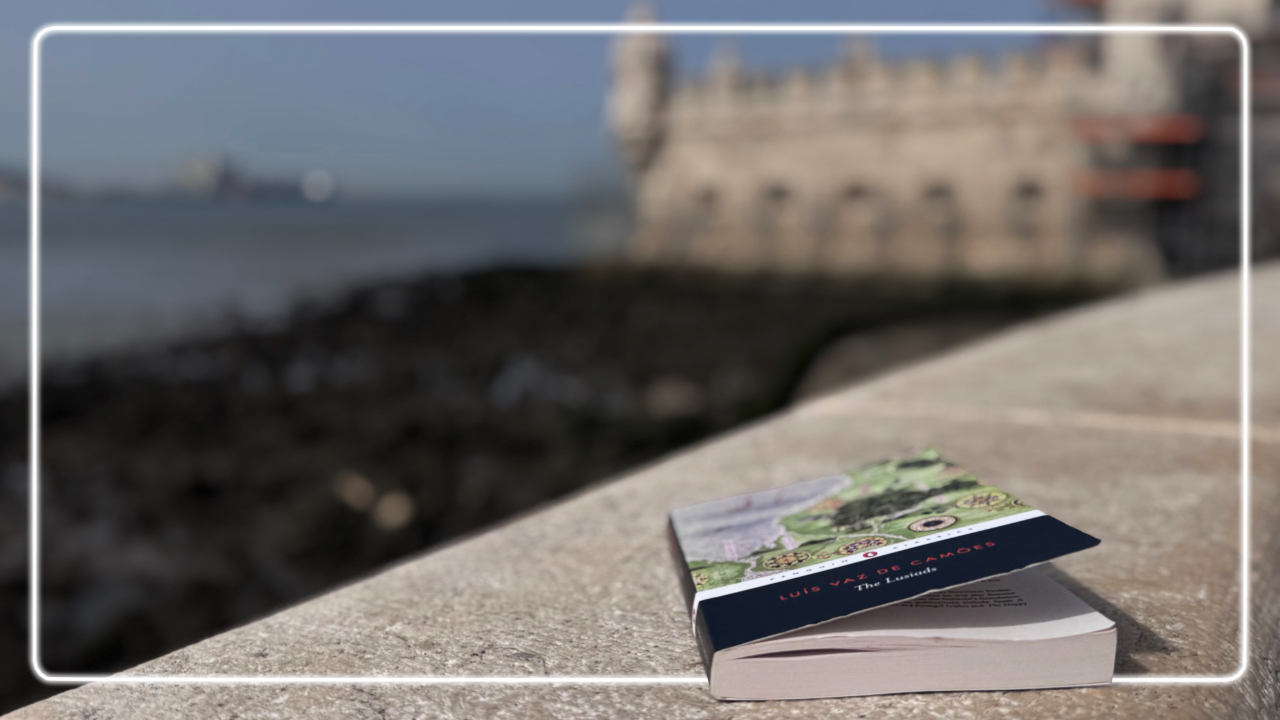
We’ll start at the very beginning – for Portuguese lit, as well as my own reading journey, with Os Lusiades (The Lusiads). Portugal, it turns out, is one of a handful of countries with a “national epic”. Written in the 1500s by Luís Vaz de Camões to celebrate the Age of Exploration, The Lusiads is widely considered the Most Significant Work of Portuguese literature. Almost every Portuguese source recommended reading it to really understand the country, and who am I to debate the Portuguese? When in Lisbon, after all…
Somewhere between history and fantasy
To be completely honest, I started my reading less than enthusiastic. The classics have never been my cup of tea, and I was worried about wading through dense stanzas of unreadable references. Fortunately for me, I’d picked up a prose translation, and the translator spent ample time explaining exactly how much he’d simplified the writing. Thus fortified, I dove into the text, unsure of what I’d find.
The Lusiads are, for a reader of modern fantasy or even modern history writing, all over the place. Some facts about the tale, as framed by Camões:
- The story follows Vasco da Gama as he sail around the Cape of Good Hope, reaches India, and sets out on his return
- It uses the Greek Gods as a framing device, citing Venus as the sponsor of the Portuguese and Bacchus as their enemy
- Bacchus literally intervenes several times, setting African Muslims against da Gama and his fellow “innocent” explorers, leaving them no choice but to murderously escape
- da Gama and his crew run into a monster, Adamastor, who causes all the storms at the Cape of Good Hope; they defeat him by talking to him
- Before returning home, da Gama and his crew end up on an island of very obliging nymphs that Venus sets up for them by as a reward for persistence
- The nymphs also tell da Gama about the next 100 years
- Venus’s goal in all of this is perpetual fame, since she thinks that if da Gama succeeds, people will associate his success with her. This despite da Gama’s persistent prayer to the Christian God throughout the epic
Honestly, it it had been written in the modern day as a historical fantasy, it would have been lauded as a tremendously creative reframe. As it stands, I found it a bit tough to get through. All those creative pieces above are sandwiched with dense retellings of emotional historical references replete with meaning to the Portuguese – think royal betrayals and dramatic martyrdoms. It’s a bit like trying to read a book that speedruns King Arthur, the Black Plague, the Wars of the Roses, and the Tudors all in one 250-page go.
For a modern reader, it’s also hard to manage the emotional whiplash of reading about the drama of a young queen, betrayed, only to have the anecdote followed by “and then Bacchus, who’s real! Did some shady shit and got the Muslims mad”. It was extremely difficult, also, to read such breathless justification and glorification of colonial conquests. (I’m of Indian origin, after all. Surely I should not be rooting for the conquerors?)
Reading The Lusiads felt like see-sawing between Serious Drama, pure fantasy, and offensive stereotypes. And yet, I would seriously recommend it to almost anyone visiting Portugal.
A cultural Rosetta Stone for a long-forgotten era
Everywhere you look in Lisbon, you see traces of Os Lusiades and the colonial story it created. The Torre de Belem? Where da Gama left for his epic journey. The Monument of the Discoveries celebrates 500 years since the death of Henry the Navigator, a central figure in exploration history. Peña Palace in Sintra marks the site where the king spotted da Gama’s return – and centuries later, a German royal consort carved a statue of Adamastor there to prove his understanding of his new home. One of the “canonical” tile patterns shows the Line of Demarcation in which Portugal and Spain split the whole to-be-explored world between them. The same symbol is on the flag itself!


The Portuguese themselves will proudly reference these elements of their history. Several locals assured me that their colonial glories were all in pursuit of just religion – no money involved! All this to say, Portugal very much considers itself the Main Character of the colonial era – and it’s proud of that fact.
As a modern Desi-American, this is somewhat baffling to me. In much of the English-speaking world, we’ve accepted that colonialism was, in fact, a Bad Thing. It killed millions in the name of extracting wealth and developing Glory. It led to horrifying systems of slavery and plantation work and required several revolutionary wars to attempt to eradicate. Globally, it created both great wealth and great inequality, and it did so by eradicating freedoms and local cultures in the name of a monocultural definition of civilization.
Not only that, but (if my education and that of those I’ve asked since my trip are at all representative) here in the US Portugal is far from the main character of that era. Growing up in Miami, we learned a ton about the Spanish and the English, but the Portuguese rarely came up. When they did, it was as navigators and explorers, a blip on the colonial historical radar. And so, seeing the story the way the Portuguese are proud to tell it was eye-opening.
It’s a perspective I’ve never really been able to internalize before, and one I could only understand with the context given me by reading The Lusiads. Being able to recognize all the different national symbols, whether it was St. George in a stained-glass window or the many, many portraits of da Gama himself allowed me to see exactly how central this story of colonial power was to the Portuguese culture. And reading these stories in full context helped me appreciate why they might be meaningful references (even if my anti-colonial heart remained cynical about their true contents).
Ready for the next chapter
All this said, reading The Lusiads still felt a bit like homework. I’m glad I read it, and would absolutely recommend to anyone traveling to Portugal. (Also, if you read it, you will impress any tour guide you meet the first time you recognize a reference!)
But after reading my medicine, I was excited to read something a bit more suited to the modern taste. And luckily, my next stop allowed me to fast-forward to spies and intrigue in WWII…
Until next time, stay cozy, and stay curious!
