
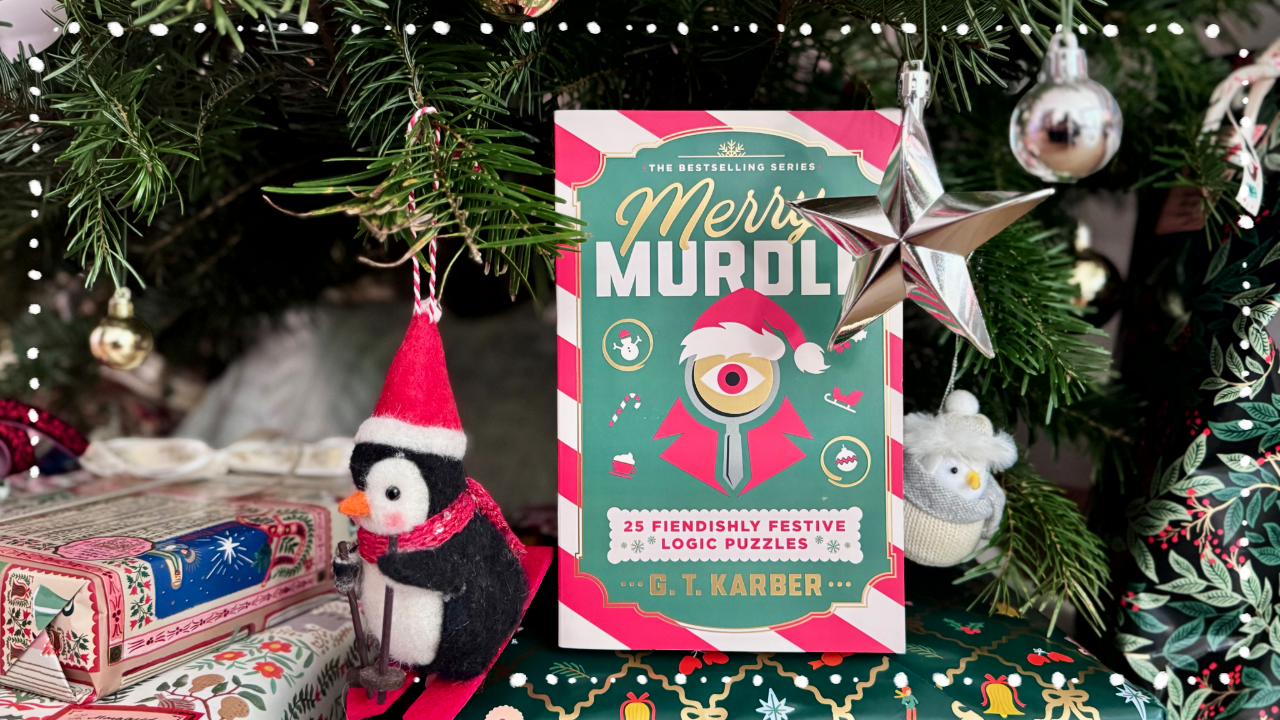
Here we are, once again, at the final entry in another Advent of Mystery. It’s our last book and our last advent calendar—one I’ve been especially looking forward to. I’ve already shared my immense love of Murdle, and I was thrilled to see the release of Merry Murdle this year.
For those unfamiliar, Murdles are murder-themed logic puzzles. Each puzzle features suspects, locations, and weapons, along with clues that help you match the three together. Over the course of a Murdle book, puzzles typically increase in difficulty—sometimes by adding a new category, sometimes by making the clues trickier. Each puzzle comes with a helpful grid to track connections and solutions.
I adore Murdles, as I’ve always felt logic puzzles are underrated in the puzzle book space. The light humor, recurring characters, and story arc are a welcome bonus. Still, fondness alone isn’t enough—I want to evaluate this advent calendar using the same bar as the last one. So let’s take a look at Merry Murdle’s puzzles (variety and effectiveness), story cohesion, and festive spirit. (As a reminder, I’ve yet to finish the calendar, so I’ll check back in once I’m done!)
A Murdle a Day
As you might expect, Merry Murdle consists entirely of Murdle puzzles. In one sense, that means the variety is fairly low—you’re solving one Murdle a day. However, Karber has divided the book into five “acts,” each introducing a new twist to the puzzle-solving.
The first act is straightforward, easing readers into the fundamentals. Act II adds codes and ciphers to the clues (all explained in an appendix—one of seven total—which add color and depth to the world while providing useful reference material). Act III increases complexity by introducing a fourth element to solve for in each puzzle. Act IV goes further, introducing fabrication: characters each make statements, but one—the murderer—is lying, forcing solvers to test each claim for consistency. By Act V, players have built a full toolkit of skills they can use to tackle the most complex puzzles yet.
Along the way, puzzles may reference different appendices or exhibits, real-world information, or even other puzzles (meta!).
All of this is to say: Merry Murdle is, fundamentally, a book of Murdle puzzles. If you enjoy logic puzzles, you’ll likely enjoy Merry Murdle; if you don’t, you won’t. But within that framework is escalating difficulty and enough variation to keep the solving experience engaging. Merry Murdle is exactly what it promises—a Murdle a day, through December.
A fun (and effective) framing device
Historically, what’s set Murdle apart from other puzzle books is its lightweight plot, complete with recurring characters and story arcs. Over time, those characters become familiar without ever overwhelming the puzzles themselves. Many fan favorites return here—I smiled to see Chef Aubergine and Dame Obsidian again.
That said, Merry Murdle is intended as a standalone, with its own contained story. Santa has gone missing from the North Pole, and Deductive Logico must determine whodunnit from a list of 25 suspects. Reasoning that anyone who kidnapped (but did not kill) Santa cannot be a murderer, Logico solves murders to eliminate suspects from the list. Each solved case crosses another name off. Thus, you don’t need prior knowledge of the characters to follow along. You simply solve each puzzle and eliminate each murderer as you go.
This framing works especially well in an advent calendar format. Eliminating suspects rather than layering on plot keeps the world contained and focused. Each story includes five suspects, and because suspects recur improbably often across crime scenes, they become familiar very quickly.
Structurally, Merry Murdle differs from previous books in one key way: solutions appear immediately after each puzzle, instead of at the back of the book. This design choice reinforces the sense of forward momentum and makes each day feel distinct. Combined with the overarching goal of rescuing Santa, every solved puzzle feels like real progress.
Festivities galore
The loose plot arc allows for a lot of creativity in settings and scenarios. Murders take place in a restaurant, on a film set, in Santa’s workshop, and even at a knockoff Winter Olympics.
Throughout it all, Karber maintains a festive tone. Whether through framing (they’re filming a Christmas movie), locations (decorated with holly, Santa’s workshop), or weapons (from a wintry icicle to Santa’s sleigh), every puzzle includes some tongue-in-cheek seasonal reference. The humor is light and well-balanced—just sly enough to suggest that a candy cane or Santa’s list could plausibly be a murder weapon.
Naturally, the overarching goal is to rescue Santa himself. Logico is initially a Santa skeptic, but he has a job to do, and he does it thoroughly. Over the course of Merry Murdle, we learn more about the North Pole’s operations, from flowcharts to campus maps. That exposure slowly wears Logico down, and while he may remain unsure about Big Red, he clearly grows to appreciate the spirit of the season.
The result is a delightful mix of goofy, satirical, and earnest holiday cheer. Merry Murdle doesn’t take itself too seriously—it just wants you to have a fun, cozy holiday season. In that, it succeeds.
So… Is Merry Murdle for You?
By this point, you probably already know whether Merry Murdle is your kind of advent calendar. If you already enjoy Murdles, this is an easy recommendation for the holiday season. If you like logic puzzles and appreciate a light sense of humor in your festive reading, it’ll be right up your alley. If, on the other hand, you prefer mysteries that take murder seriously or want a broader mix of puzzle types, you may want to look elsewhere.
As someone who loves Murdle, this one hit the festive, puzzly spot.
And that’s it for all my mystery reads this year! I’ll be back tomorrow with a recap and some final thoughts. Until then—stay cozy, stay curious, and I hope you and your loved ones have a wonderfully warm Christmas Eve.
