
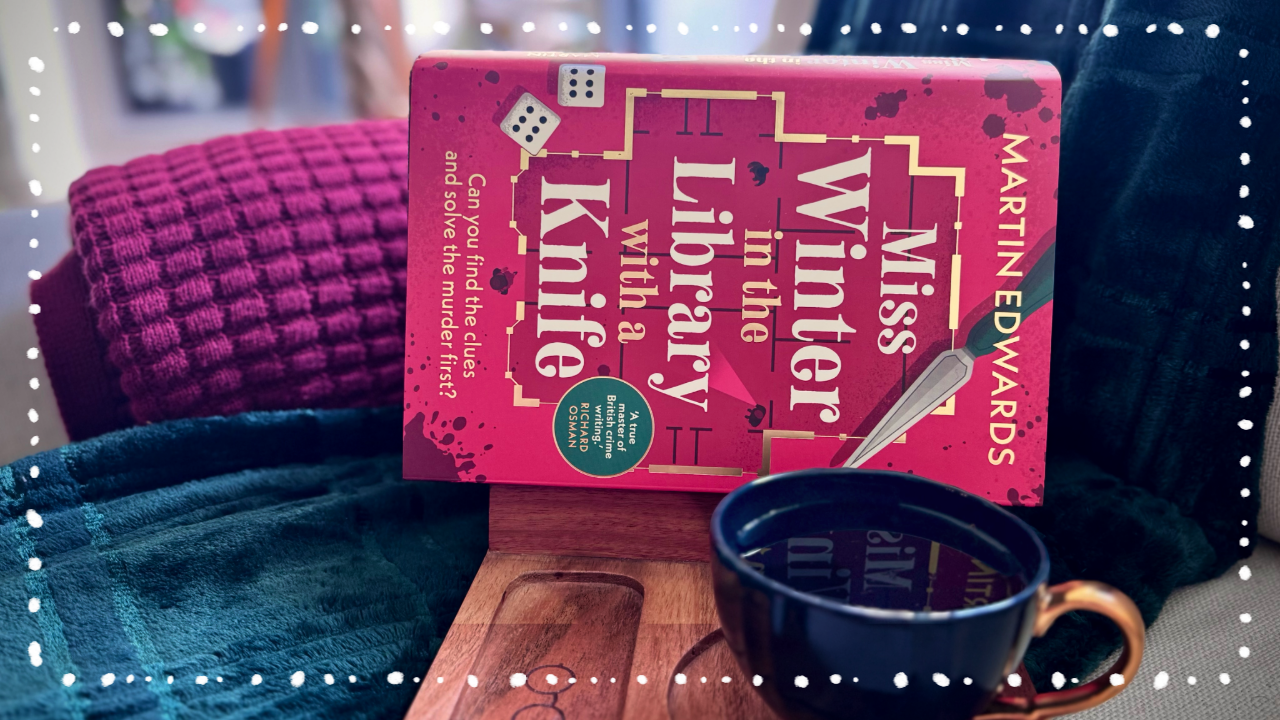
It’s time for the last of our luxurious Christmas vacation stories, and this one comes with an extra-mysterious twist. Martin Edwards’ new standalone, Miss Winter in the Library with a Knife, promises his usual fair-play sensibilities with a distinctive wintry edge.
For those not familiar with Edwards, he’s the current president of the Detection Club and a prolific Golden Age mystery anthologist. His Rachel Savernake series is scrupulously fair play, referencing Golden Age traditions while adding modern ethics and linguistic sensibilities. Edwards, in other words, is well-versed in mystery tradition—and well-poised to create the ultimate winter puzzle.
The marketing for this book highlights the puzzle component specifically, and we’ll get to that soon. But first: the mystery? The festive vibes?
Puzzles on puzzles, redux
Miss Winter in the Library with a Knife is explicitly framed as the story of a murder-mystery game. Six people, each with some connection to crime publishing (and some associated failure), have been invited to play along by the mysterious Midwinter Trust. Edwards plays fair here, sharing the clues diegetically and allowing the reader a genuine chance to solve them. Most often, we encounter each clue or puzzle from the perspective of Harry Crystal, failed crime writer and hopeful contestant.
But a murder game isn’t much of a murder mystery, and reasonably soon into the story we encounter real murder. At first, there’s some doubt as to whether the deaths are accidents—though not for anyone coming to this book for Edwards. It becomes pretty clear that there’s some real murder / serial-killer business happening.
Underlying all of this is the mystery of the Midwinter Trust itself. What is this town, with its tiny population, mysterious history, and conspiracy-theory websites? Why do so many people try to hide specific elements of the town’s details? What is the “real” prize for the winner of the game? Adding a nice extra layer of puzzling is the variety of formats Edwards uses, ranging from standard narration to journals and even webpages. (Technically, epistolary!)
As you can see, Edwards has layered the mysteries on thick. I wouldn’t say any of the individual mysteries are especially surprising, but they’re woven together well, resulting in a satisfyingly dense pile of clues to dig through. Edwards is, of course, strictly fair play—and even includes a clue finder at the end.
Christmas cheer (with a sharp edge)
If all of this starts to sound a bit like earlier Christmas reads this year—yes, it is. Across his work, Edwards seems particularly interested in frustrated or tortured souls. In this case, the six guests at Midwinter have plenty to be frustrated about. Their publishing careers have all sunk, sometimes quietly and sometimes in a blaze of scandal. None of them are especially pleasant, though the main POV character, Harry Crystal, has a slight Eeyore quality that may endear him to some readers.
This means that, despite being set over the Christmas holiday, the initial vibe sits somewhere between tense and actively competitive. There are nods to the festivities—in decorations and in the menu—but the focus remains firmly on the mystery and the interpersonal tensions.
Then along comes a murderer, and things grow significantly more intense. I’d almost go so far as to call it a thriller… except for some specific narrative and plot choices that keep the overall tone feeling a little more lighthearted, ridiculous, or even goofy—at least to me. Overall, however, the tone is apt for the darkest day of the year – dark enough to feel it, light enough to look forward to the sun just around the corner. (If you read this and have guesses about what I mean, I’d love to hear your thoughts in the comments!)
Snow, Competition, and a Side of Strife
Then we come to the question of the puzzles themselves. My enjoyment of these depends entirely on my own ability—and willingness—to solve them. Some piqued my fancy more than others: I can happily leave most ciphers behind, but I enjoyed several of the more narrative-driven puzzles.
For readers who love solving everything, Edwards includes a wide variety throughout the book. It’s never quite the same type of challenge twice, and the puzzles genuinely reward taking a moment to engage with them, if that’s your preference. As an avid mystery reader, though, I’m not necessarily looking for my puzzles to be called out quite this explicitly. Over the years, I’ve learned to engage with them selectively—only when they help me connect more deeply with the story. If a puzzle aligns with my particular strengths, I’m happy to give it a try. If I hit a wall, I’d rather keep moving.
After all, in this book (and others like it), the most important clues aren’t always in the puzzles themselves, but in how the characters respond to them. Who solves them first? What tools do they use? How do they speak to those still struggling? As someone who prioritizes the mystery novel over the activity-book aspect, that’s where the most interesting information lies.
Fair Play in the Snow
Edwards continues to be a consistently fun writer of traditional, fair-play mystery. Miss Winter in the Library with a Knife is great fun for the seasoned mystery reader. It’s chock-full of clever genre references, layered puzzles for those willing to suspend their disbelief about the framing device, and a satisfying sense of seeing all the pieces click into place. And it’s all genuinely solvable, which should warm the hearts of fair-play fans everywhere.
We’re sticking with tradition in tomorrow’s holiday mystery read—and then it’s time for some Advent calendar fun. (Meta, I know!) Until next time, stay cozy, and stay curious.
