
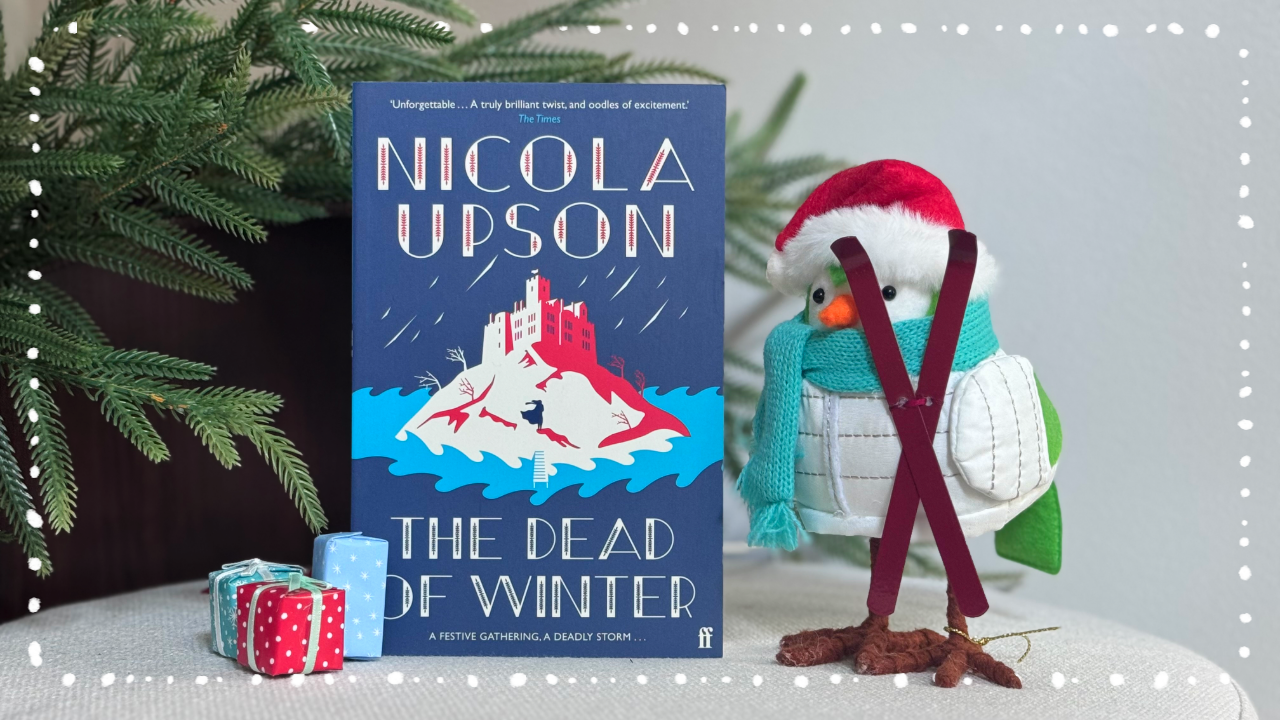
Today, we’re sticking with luxury holidays, but moving from the present to the past. After reading The Christmas Clue, I decided to look a bit further into Nicola Upson. I quickly learned that she writes a series of mysteries featuring Josephine Tey. Not only that, but the series has a Christmas entry — so of course I had to read it.
In The Dead of Winter, Tey and her (more than) friend Marta are invited to Christmas at a Cornish estate. Their role is to add some liveliness to an otherwise drab gathering — at least, apart from the movie star in attendance. The two are looking forward to a luxurious holiday together. But when guests start getting murdered, it’s up to them and their friend Archie Pinrose to uncover who’s behind it all.
By this point, my general rubric for holiday mysteries will be familiar: there’s the mystery and the festivity. But because this novel deals with historical figures — and quite famous ones — I also want to consider those portrayals… Let’s dive in.
The Mystery: Layers of plot – but not fair-play
There’s a lot of mystery to unpack in The Dead of Winter. The book opens in the 1920s with a horrific family killing, then leaps ahead by eighteen years. Any mystery reader worth their salt will know that this earlier crime will eventually matter… But then there’s yet another death, almost an accident and seemingly unrelated, that throws the whole plot for a loop.
By the time Josephine and Marta arrive, readers are left wondering how this later murder relates overall. When more deaths begin to occur, the story becomes both a whodunnit for the recent crimes and a howcatchem for the earlier one. Layered on top of that is the open question of how — and where — the 1920s story ties into everything else.
With all these threads in play, it’s almost easy to miss that this mystery is not fair play. The characters’ ability to solve the case is gated by both visual information not shared with the reader and legal details Archie delegates to a subordinate off-page. The result is a novel full of intricate plotting, but not one that’s strictly solvable by the reader. (Upson has mentioned she appreciates the psychological nature of Tey’s works, so this may not be a strict minus.)
Christmas at the Edge of the Abyss
What about the festive spirit? This story is set just before the outbreak of full-scale World War II, and that tension permeates the pages. Remember that Josephine and Marta have been invited in part to make up numbers — and to liven things up. It’s a smart decision by the host, because these guests range from dull to outright unpleasant. (Also, one of them is a murderer.)
As a result, most of the Christmas scenes are awkward at best. More poignantly, the host is contemplating the loss of her home when her father dies, thanks to the rigid laws of primogeniture. A significant portion of the book is spent in a kind of premature mourning for a titled way of life that is already slipping away. Between that grief, the tension of the howcatchem, and the fear generated by multiple murders, the novel often reads more like a thriller than a cozy mystery.
There are, however, two festive bright spots in The Dead of Winter. The first is Josephine and Marta’s genuine delight in being together, along with the thoughtful gifts they exchange. The second is Marlene Dietrich, the mysterious guest mentioned earlier. Upson writes her as sparkling and charismatic, the undeniable center of every scene she inhabits. It’s Dietrich who makes the strongest case for celebrating Christmas however you can — though it’s a spirit the book itself rarely sustains.
This is a version of Christmas shaped by mistakes, sadness, and guilt: a much darker vision of the holiday than many readers might expect.
Reimagining Josephine Tey
Finally, there’s the historical element. Josephine Tey — born Elizabeth MacKintosh — was a fascinating and private figure. While her writing remains well known within crime fiction circles, she’s far less famous than many of the other Queens of Crime. As a result, relatively little is known about her personal life, giving Upson a fairly clean slate to work with.
Upson has clearly done her research, and that grounding shows. Still, she fills the gaps in Tey’s biography with an almost unbelievable amount of murder. It’s difficult to imagine the famously reserved MacKintosh solving — and covering up her involvement in — so many deaths while also maintaining a successful career in fiction and theatre. Perhaps her social circle really was as open and accepting as the novel suggests, but it’s hard not to read this portrayal as wish fulfillment rather than historical likelihood.
That said, wish fulfillment is arguably what one expects from a Christmas installment. I’d be inclined to try another book in the series to see whether it feels more historically grounded outside the holiday framework. If you already enjoy Upson’s Josephine Tey novels, The Dead of Winter is probably worth adding to your reading list. Alternately, if you’re intrigued by the feminist and pro-LGBTQ elements, more so than the festive spirit, this might work. But if you’re specifically looking for a Christmas mystery, this may be one to skip.
I promised multiple luxury Christmas holidays, and the best is yet to come tomorrow. Until then — stay cozy, and stay curious.
