
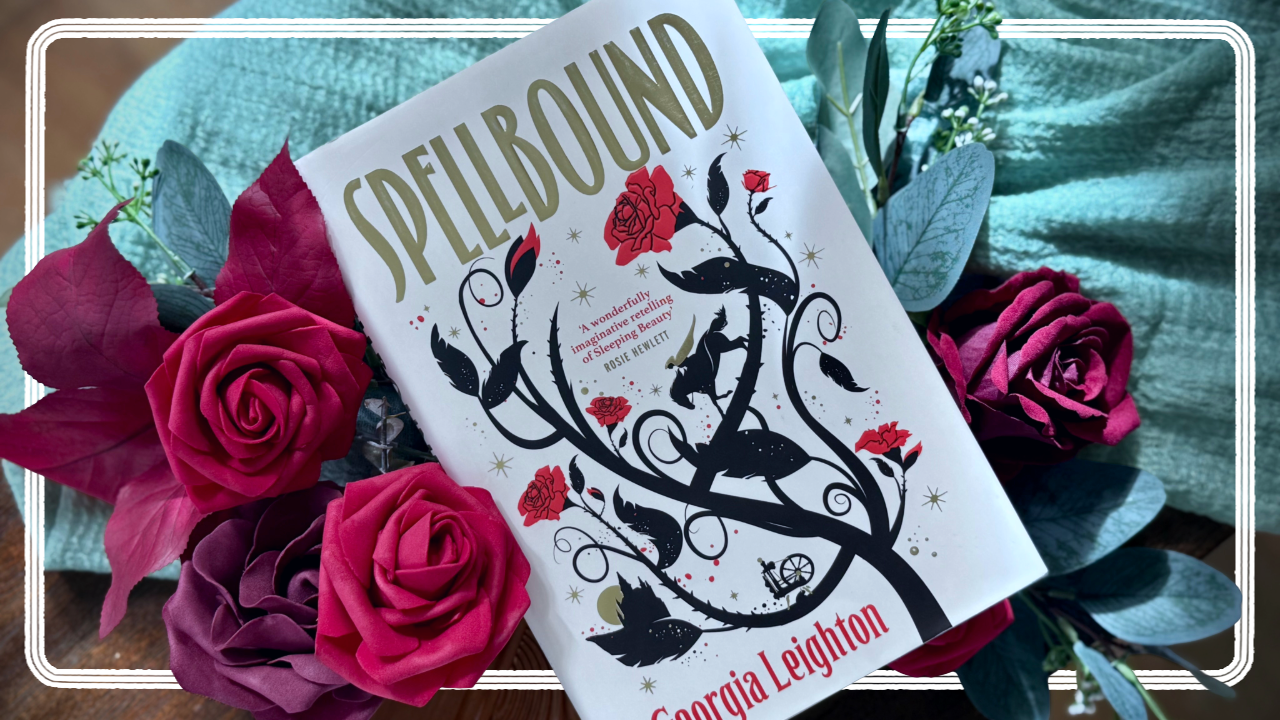
It’s been a minute since I posted some good, old-fashioned book thoughts. But this week I found an absolutely perfect mid-fall read, and I knew I had to share. It’s a Sleeping Beauty retelling called Spellbound, and its contemplative take on a generally simple story was a refreshing break from my usual intrigues.
I love a good fairy tale retelling. Most fall into one or many of the following categories: feminist character study; creative new magic system; alternate mythology / culture setting; and / or modern-day transplant. Spellbound is essentially the first, with hints of the second: while there’s some sense of a magic system, it’s only explained enough to enable character exploration. But the real question is – how well does it hold up to its promise of a feminist retelling?
You’d think retelling an existing story might be easier than creating a new one from scratch. But for any retelling to succeed in my book, they must have a few characteristics: respect for the source material, curiosity about its hidden depths, and a world and characters worth exploring. This can be a tricky balance: for example, it’s easy to focus too much on the world (“hidden depths”) and end up with a flat fairy tale (failing “respect for the source material”). The best retellings make me question my acceptance of the original story, and appreciate the new perspective. (This is not the same as a “grimdark” approach. Many fairy tales are hopeful and deciding to “reinvent” one by eliminating all positivity just doesn’t do it for me.)
It’s a lot to balance, so many pens to keep in the air at once. It’s no wonder so many fairy tale retellings stumble… So how well does Spellbound hold up? (Warning – spoilers below – be warned!)
A kingdom’s worth of POVs
Spellbound follows several women over 17 years and two generations. There are the parents – Queen Violanna, her lady-in-waiting Lady Meredyth, Sel – and the younger set. The story opens basically as you might expect – queen gives birth, there’s a blessing ceremony, scary curse to kill the princess and keep the queen in her castle! Sad.
Except (and here is your very final spoiler warning!) unlike in the original story, the Queen has a second baby – a twin, untouched by either blessing or curse. She chooses to keep this child a secret, sending her firstborn away in hopes of tricking the curse. It’s this first child, Briar, who goes off with Master-in-Training Sel, while her sister Talia is raised as the Princess.
This is a lot of perspective characters, and most add depth and layers to the story. We read about Talia’s fear and isolation, and pity how the court ignores her. We understand Lady Meredyth’s frustration at the situation and admire her determination to get Talia support and education. Briar’s voice joins a little later, but she forces reflection on how difficult a life in hiding is, especially from the lens of connection. Violanna is perhaps the most one-note, as most of her thoughts are either stressed countdown or sorrow.
But mostly, the story centers Sel, the young Master-in-training who attends Briar’s blessing ceremony in place of her former Master. Sel goes from nervous apprentice to sudden mother-on-the-run, giving up everything to protect Briar. She does this hoping for a reward initially, but comes to love her adopted child. And her biggest challenges is therefore keeping such a big secret from her.
…divided by their secrets
At its core, Spellbound is a story about secrets between generations. Every single one of the mother figures keeps at least one secret from her children. They do it to both to protect them and to avoid extremely difficult conversations. Violanna has an added dose of guilt, as she’s got her own secret from the kingdom.
But no matter the intentions, the secrets have a way of getting out to the younger generation. And their reactions to the secrets – both are fighters, though Briar is a bit more action-oriented and Talia focuses on gathering facts – drive the plot and the curse forward. It’s a tale as old as time – parents trying to mete out information, and children rooting it out regardless.
It’s a testament to the character writing that you can read each chapter and imagine what every other POV character must think of the events, how they’d react if they knew. By the time of the climax, when all the characters have (inevitably) gathered, it’s a fun game to figure out what might happen, how the story might resolve itself. And it’s here, for me, where things go a little off the rails.
When the curse (sort of) comes due
I won’t go too far into the details of the ending here, but I do want to capture my reaction. Spellbound is a Sleeping Beauty story, and so the ending must involve some kind of time freeze, the curse coming true, a spindle, and the curse lifting. The ending does, indeed, include all those components. But it doesn’t necessarily earn them, particularly the spindle.
This comes from both an over-emphasis on the characters and an under-emphasis on the magic system / worldbuilding. The story wants to spend as much time establishing Briar and Talia as interesting as possible, so neither spends much time spinning. And when it’s with Sel, the only magic-user, it wants to focus on her as a person rather than a Master. In fact, we learn very little about how any of the magic works. So it’s not ever really clear why a spindle is involved in the curse, or in breaking it.
This somewhat deflates the impact of the ending, making it feel very deus ex machina. The curse has lifted, but it’s not exactly clear why it worked. The characters are on similarly uncertain paths – it’s not clear how much their lives have changed as a result of the ordeal. The princesses undergo remarkably little evolution, mostly hewing to the paths carved for them, though presumably with more freedom. In fact, it’s the supporting women – Meredyth and Sel – who evolve the most over the story, with Sel’s ambitions changing dramatically as a result of her experiences.
Final thoughts: cozy, warm, and a little wobbly
The net result is a story that doesn’t exactly know what it wants to say – about its source material, or its own themes. The most effective part of this retelling is in the character studies, especially those of “side characters” like Sel and Meredyth. But while it brings out the variety of female experiences across ages and classes, its challenges with its source material somewhat rob the characters of real agency. It begs the question – would this have been a story better told without the spindle?
I will say, I really enjoyed reading Spellbound – it’s the fastest I’ve read something in a while. The characters are interesting and it’s fun contrasting their perspectives on the events of the story. The thoughtful characters combined with the cozy fantasy setting made it a great fall evening companion, and I walked away feeling like I’d met each of these women. Five new fictional friends – not bad for a single novel.
Speaking of retellings: it’s almost Thanksgiving, and I’m very excited for what I have on the slate. Think alternate history instead of alternate fiction… Also, I’ve finished my 52 Book Club Challenge, so I’m due a roundup soon. Lots to come!
Until next time, stay cozy and stay curious…
