
Just when I thought I’d got the hang of this reading-while-traveling thing, my latest trip threw me for a loop.
Earlier this month, I was told I needed to travel to Abu Dhabi for work. Never one to waste a good trip, I dove into my usual pre-travel ritual: building a reading list rooted in the region. On recent trips, reading books tied to my destination—especially ones with a historical or fantastical flair—has deepened my experience of place. Even when the stories lean into fantasy, they’ve consistently illuminated pieces of local culture and mythos I wouldn’t have otherwise discovered.
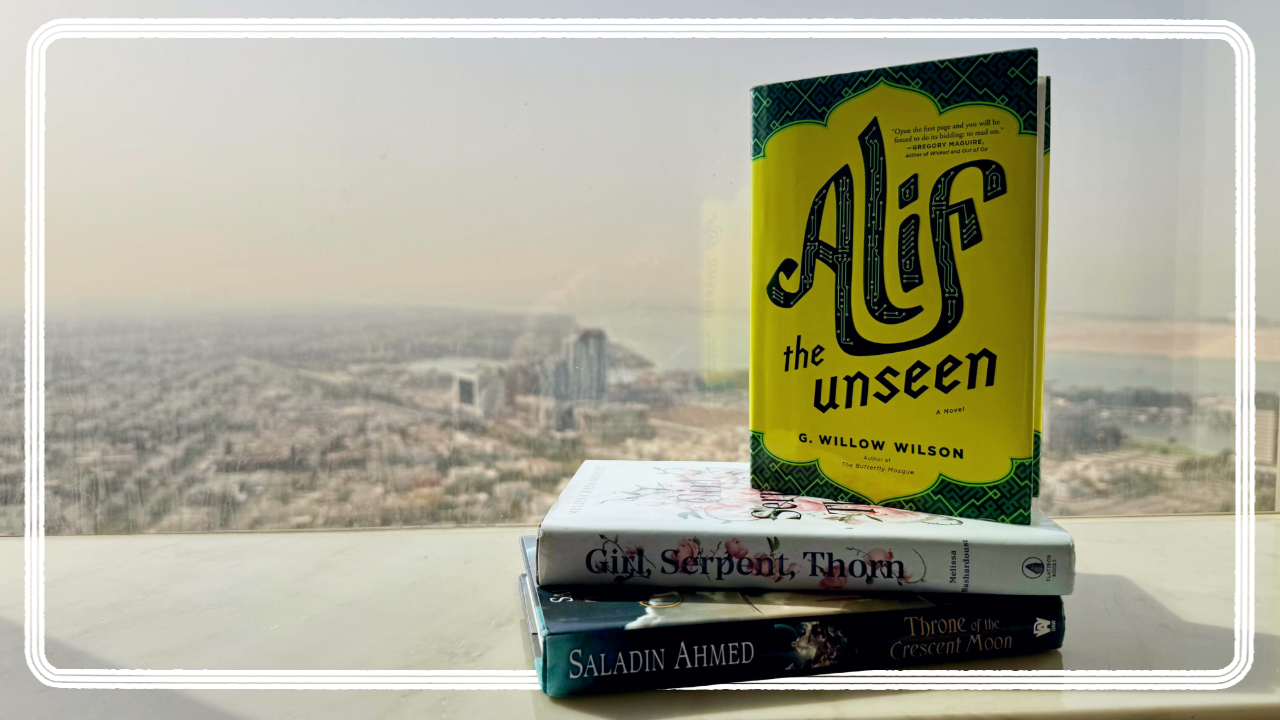
I chose my books with care. There was Saladin Ahmed’s Throne of the Crescent Moon, a Hugo-nominated historical fantasy that leans heavily into Thousand and One Nights lore. Then came Girl, Serpent, Thorn, a Sleeping Beauty remix inspired by the Shahnameh and Persian folklore. And finally, I revisited an old favorite: Alif the Unseen, a cyberpunk-inflected tale of revolution, surveillance, and djinn, which I only now realized had won the World Fantasy Award. All three authors had personal or cultural ties to the Middle East, and I chose them for that authenticity—even though, to my mild annoyance, they were all fantasy. (There’s definitely a market gap, in the U.S. at least, for a cozy mystery series set in the Middle East. Someone please write that!)
I was hoping for the kind of immersive experience I’ve felt on past trips—when books and travel echo and inform one another. Even if I didn’t love everything I read, I expected a resonance. But this time? Not so much. Let’s unpack that.
A consistent cultural portrait…
Reading fantasy rooted in another culture always comes with some degree of risk. It’s hard to tell whether what you’re absorbing is the product of lived experience, rigorous research—or just stereotypes dressed up in narrative. That said, I’m not unfamiliar with Middle Eastern fantasy. I’ve read my share of djinn stories and sword-and-sand sorcery. I felt reasonably well-prepared for this literary excursion.
The books delivered what I expected—stylistically, thematically, and atmospherically. Throne of the Crescent Moon introduces ghuls and conspiracy from the edges of empire. Girl, Serpent, Thorn plays with djinn myth and transformation, interweaving court intrigue and self-discovery. Alif the Unseen, the most contemporary of the three, combines internet censorship, digital rebellion, and djinn magic to explore surveillance and social unrest.
Surprisingly, despite their differing genres and tones, the books paint a broadly consistent portrait of the Middle East: conservative, somewhat insular, and imbued with an ambient sense of magic that most locals ignore. These are societies riven by classism and patriarchy, often harsh toward outsiders. In each, the ruling class suppresses dissent, magical or otherwise. The desert, meanwhile, looms large—both physically and metaphorically—as something to cross, to survive, or to be tested by.
There are, of course, distinctions. Throne of the Crescent Moon adheres closest to traditional fantasy tropes, for better and worse. Girl, Serpent, Thorn adds more dimensionality to its djinn and gives its women more agency, even as their roles still revolve around traditional expectations. Alif the Unseen is more current, exploring Islamic identity and gender through complex female characters like Dina, the Convert, and Intisar (sadly, none the protagonist). Still, all these stories share a rearward gaze. They’re less about the contemporary Middle East and more about archetypes.
This narrative pattern isn’t isolated to just these three. Over the years, I’ve read a slew of Middle Eastern fantasies, and similar themes resurface repeatedly. From P. Djèlí Clark’s steampunk Cairo to Chelsea Abdullah’s desert-faring thieves to Alwyn Hamilton’s rebel outlaws, many of these tales explore social hierarchy, oppression, and the uncanny desert landscape. (One refreshing exception: The Adventures of Amina al-Sirafi, which centers a female pirate captain whose authority is never questioned and whose world reflects the diversity of trade-era Islamic society.) Mostly, the vision is consistent.
…that tells much less than the full story
So you can imagine my expectations when I landed in Abu Dhabi. I half-expected a sea of sand and conservative gazes—especially with my fantasy-colored hair. And sure, I was braced for heat and formality. But what I encountered was something else entirely.
My first real surprise? Corniche Beach. Miles of shimmering blue ocean, open for swimming even in sweltering temperatures—utterly different from the arid, forbidding landscapes I’d envisioned.
Then came the hotel breakfast, a miniature United Nations of cuisine: eggs and turkey bacon alongside congee, gyoza, and uttapam. This trend continued throughout the trip. I ate poké and pasta, alongside chicken maqboos and karak chai. The food culture was less a celebration of “tradition” and more an elegant embrace of globalization.
The people? Warm, proud, and engaged. Every conversation included enthusiasm for the city’s safety and diversity. Immigration was not just accepted but celebrated. The women I met, particularly in professional settings, commanded attention and respect—no side-glances, no tokenism. Their perspectives were integral, often driving key parts of the discussion. Lunch and dinner conversations spanned everything from AI ethics to regional business strategies to parenting styles across cultures.
Admittedly, I only visited for a week and spent most of it in meetings. But even in that short time, the contrast between what I’d read and what I experienced was stark. Abu Dhabi was not a closed-off, culturally monolithic society. It felt instead like a crossroads—a city-state shaped as much by ambition and openness as by tradition. I don’t want to over-romanticize the place, and I’m sure more time there will lend me a more layered perspective. Still, I’ve never encountered such a disconnect between fictional portrayals and on-the-ground reality.
Some reading reflections
So where does that leave me?
In terms of recommendations: Girl, Serpent, Thorn is a strong pick if you enjoy fairy tale retellings and morally complex protagonists. Alif the Unseen remains one of the most original books I’ve ever read, with a deft fusion of politics, mysticism, and code. It’s especially compelling if you’re into technomagic or want to explore philosophical questions through fantasy. Just remember, it’s of its time—a snapshot of Arab Spring-era anxieties.
Lovely as they are, these books didn’t quite prepare me for the very real, very modern bustle of the UAE. If anything, they might obscure the view, reinforcing an outdated or over-simplified cultural frame. For that, I think I need to shift gears—toward nonfiction, memoirs, and journalism. To better understand the modern Middle East requires stepping outside the realm of myth and magic.
So that’s my plan going forward. I’ll still seek out fantasy set in the region—but I’ll do so remembering what it does and doesn’t capture. And I’ll balance it with stories grounded in lived present-day experience. (Any recommendations?)
Until next time – stay cozy, and stay curious.
