
So.
I’ve been a big flake the last few months. In that period, I have:
- Hosted family
- Completed a theme park road trip
- Completed another trip (to Seattle) for work
- Completed yet another trip (to France), also for work
- Completed a fourth trip to Italy
- Had a little staycation in Sausalito
What I have not done, however, is write a non-travel blog post… but not for lack of reading. (In fact, I may have pulled an all-nighter last night devouring a new-to-me fantasy series about djinn.) I’ve read everything from bibliomysteries to cozy school fantasies, literary comfort food and surprising genre benders. And I’m so excited to carve out some time and share my favorite reads with y’all.
A new type of mystery
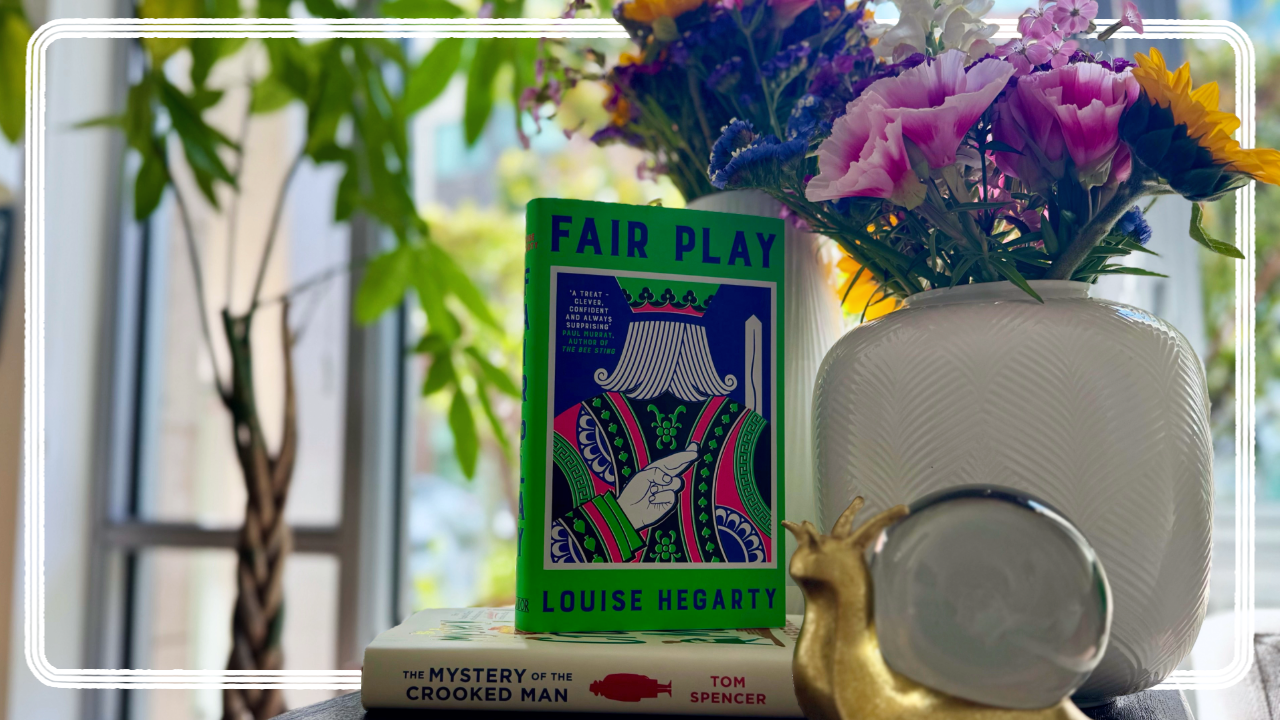
We’re going to start with a duo of books that are, on their face, somewhat different. Fair Play by Louise Hegarty follows Abigail, whose brother dies at his own murder mystery party, an apparent suicide. What follows seems to be a locked room mystery, as famed detective Auguste Clement starts to investigate. But something is off – and about halfway through the book it’s clear that Abigail’s grief may have led her into… unorthodox coping mechanisms.
Tom Spencer’s The Mystery of the Crooked Man, instead, starts off with a literary hoax. His spiky protagonist Agatha Dorn “discovers” a lost manuscript from a famous Golden Age author – which turns out to be a fake. Things get even worse when her ex-lover (and her mother’s carer) turns up dead. The resulting story follows Agatha as she investigates both the death and the hoax – all while her life spirals out of controls.
I read these books in quick succession this April. What immediately stuck out was the treatment of both protagonists’ grief, as something real and lasting and meaningful. Both Hegarty and Spencer subvert modern mystery conventions to explore that grief. And if there’s one thing I love, it’s exploring shared subversions to understand a genre more deeply. So – let’s dig in.
When cases get too personal…
Rule #1 of the modern mystery – don’t let it get too personal.
It’s rare that a modern mystery story allows a protagonist to experience real, personal grief. Typically, protagonist-detective are arms-length from the crimes they investigate – it’s a friend of a friend, not someone they know or love. A loved one may be (wrongfully) suspected by the authorities, but stakes are typically jail time and / or business failure. If there’s a family member to investigate, they’re missing (and have been for years). Structurally, these mysteries are meant to be part of a series – and a series full of intense grief would likely buckle under its own despondency.
Both Hegarty and Spencer break that rule from the very start. In Fair Play, Abigail’s brother passes away – and Abigail starts looking for clues to disprove the theory of suicide. In The Mystery of the Crooked Man, it’s Agatha’s former lover, with Agatha piecing together how someone so vivid could have killed herself. Both protagonists pursue every path to establish that their loved ones were, in fact, murdered – and not simply suicidal.
This has several implications for both stories. For one thing, they take place over months, not weeks. Abigail and Agatha trace and retrace their steps, their thought patterns, every piece of “evidence”. Hegarty cleverly portrays this as Abigail’s “witness statements”, full of revisions and edits as the novel progresses. Spencer simply shows us Agatha’s actions, allowing her to spiral well outside social norms. This drives alarm and, eventually, isolation from both protagonists’ social circles.
…and protagonists lose their pep
This, of course, violates Rule #2 of the modern cozy mystery: never lose your optimism. Modern cozy mystery protagonists are a boundless stream of energy and can-do-it attitude. Their perseverance often persists through threats, intimidation, and legal mishaps. So focused are they on their puzzly and familial goals that all other concerns seem to fall away.
This is not how real humans behave. (None of the five stages of grief are “successful problem-solving”.) It’s natural, in the face of the ambiguous and unworkable, to feel confused and frustrated. And both Abigail and Agatha show us different sides of a more “real” reaction to the situation.
In Fair Play, Abigail circles over and over through the investigation. We see her revise her witness statement as time goes on. Hegarty shows us Abigail’s crossed-put musings, which reveal her grief, anger, and frustration. As Abigail’s confusion ramps, so do the workings of Clemente. And thus little by little Hegarty reveals the fullness of Abigail’s pain – something so little discussed in the cozy genre.
Spencer takes a more direct and explicit approach to showing us Agatha’s grief. Agatha’s downward spiral takes months, as she loses any social skills and drowns herself in drink. We get to cringe through her awkward interactions with former coworkers, friends, and family. Spencer is clear that Agatha does not handle her losses – of her former lover, of her beloved job – well. And that seems much more human a reaction than the peppy protagonists of cozy mystery.
Illogic in the face of grief
The reality is that grief is not rational, and confronting it takes more than logic. Abigail’s journey requires accepting that there’s much she didn’t know about her brother, and that even if she learns it, she can’t get him back. And Agatha has to dive deep into her relationships and her sense of self to make sense of the death she encounters.
These protagonists must grapple with feelings of loss, confusion, and disappointment. In the face of death, they learn unpleasant truths about their loved ones that make them question their relationships. These are stories of pain, and stories of sense-making. But making sense of an arbitrary death via red herrings necessarily involves a lot of poor assumptions along the way. Neither Abigail nor Agatha is always, or even primarily, right. And in this context, with their pain, that’s ok.
Fittingly for the theme of grief, at least one of these stories fails to resolve. What starts as a locked-room mystery pivots to a full exploration of loss. The protagonist’s story ends not when she’s found a culprit, but when she’s accepted the new hole in her life. This ending has caused some surprised reactions from Goodreads reviewers, who came expecting a locked-room mystery. (Spoiler warning for that link as you’ll know which story fails to resolve!) Personally, I find this exploration much more surprising and satisfying, though I wish the book were marketed more accurately.
The cozy detective, deconstructed
Both Hegarty and Spencer clearly love traditional cozy mysteries. Fair Play and The Mystery of the Crooked Man abound with references to Golden Age classics. These are authors who know this genre well, and their departure from its traditional trappings is a choice.
The results are stories that act as a foil to the genre they grow out of. Where cozy mystery protagonists solve cases that are one step removed, these protagonists face the death of a loved one. Where their cozy mystery counterparts stay peppy in the face of danger, these protagonists unravel in the face of their grief. And where cozy mysteries end in a logical summation, these stories wallow in feelings of loss, frustration, anger. In other words, these stories bring out the human side of murder mystery, highlighting how inhuman cozies can be by contrast.
What’s fascinating is that cozy mysteries try to satiate their readers’ need for connection. Their stories are full of warm community events, of friends and families banding together in the face of crime. But these stories highlight what they skim over – that connection necessarily means pain, that to be human is to cry and grieve and fail, not just to triumph. And somehow, that feels just as cozy a message to me.
Until next time – stay cozy, and stay curious!
Fair Play will count as my book that has a final sentence of six words or fewer (four!) for this year’s 52 Book Club Challenge.
