
From Rome, we took a quick train ride to Firenze / Florence. Fresh off the Roman nonfiction success, I was excited to repeat the approach and see how I felt. And for Florence, that meant reading about the Renaissance. As I would soon discover, the city center preserves that era, eschewing the more layered approach in Rome. (This is, in part, because there wasn’t that much Roman history to preserve.)
We started our trip with a wonderful cooking class in the Tuscan hills. (If you’re planning a trip, check out Accidental Tourist – we had a perfect evening of pasta and conversation.) We were dropped back off at the Ponte Vecchio. Thus, my first view of the city center was on a nighttime walk across the city. Everything was beautiful, but I immediately fell in love with Santa Maria del Fiore. (In fact, I took several photos every time we passed, stashing a glut of blurry Duomos in my camera roll.) So it was fitting that I started my Florentine reading adventures with Ross King’s Brunelleschi’s Dome.
The Duomo! IRL…

For those not familiar, Santa Maria del Fiore is a striking cathedral. The exterior is covered in three colors of marble – dark, blackish green, coral pink, and pure white. The Neogothic design is striking – others in Florence try to replicate it, but fail to match the richness of color and the resulting splendor. It’s capped by a tall, octagonal dome that you can see from anywhere in the city center. While a tour guide dismissed the interior as bare, the dome itself features the largest fresco surface in the world. The interior also features several artistic contributions from Ghiberti and Donatello). The whole thing took over 170 years to build.
I already knew a bit about the Duomo from my high school history classes. Built over 16 years, the cupola of Santa Maria de Fiore remains the largest brick dome in the world. Its design is one of the greatest architectural puzzles of the age; we still don’t know details of Brunelleschi’s plans.
And it was sitting under this magnificent structure that I was fortunate enough to start reading Ross King’s history of the building effort, Brunelleschi’s Dome. (Note that to have this experience, I had to acquire tickets to climb said dome, chicken out, and sit on the bench of shame until my party came to meet me. But, in my opinion, it was worth it. There is really nothing that compares to sitting inside an architectural marvel, looking up at the completed work as you read about the immense difficulty and challenge required for its construction.)
…and the Duomo, in chapters
And what a challenge it was. King lays out a detailed history of the cathedral and its inventor. Construction started in 1296 against a beautiful model that nobody fully knew how to complete. Still, architects were marched in to look at the model yearly, swearing to build only against it, never to deviate. When it came to the grand dome, this would prove a huge challenge.
Before we can get to that challenge, though, King wants us to spend time with Brunelleschi. He spends more time with the future capo maestro, showing us his fierce independence, his prickliness and his pranking nature. There’s the famous story of the competition against Ghiberti for the Baptistry doors. But King also tells us of Brunesleshi’s time in Rome, and his fondness for pranks. King enjoys describing his mercurial protagonist (and building our empathy for the Opera del Duomo, his managerial team).
Once Brunelleschi has 1) lost the baptistry door competition; 2) run off to Rome to look at domes and herringbone patterns; and 3) returned to enter the competition for the dome design, King again delves into the difficulty of the architectural challenge. Over several chapters, King describes not just the original plan, but also new technology designed by Brunelleschi to reach the dome’s summit. (These were the sections I read in the Duomo itself. It’s a breathtaking experience to look up at the top of the construction and imagine large wooden proto-cranes reaching to the top, or masons swinging across the cupola over a large wooden “safety net”.)

Of course, 16 years (while speedy in dome construction time!) is more than enough time for other shenanigans to occur. Brunelleschi, while primarily occupied with the dome, spent time on other side projects, including a weird failed boat and support for Florentine war efforts. These sections still felt a little too detailed for me, as they included detailed plans of the projects in question. But they rounded out the portrait of Brunelleschi, establishing firmly his strengths and weaknesses. Overall, though, reading Brunelleschi’s Dome in Florence added to my already overflowing love for the Duomo.
From architecture to book-binding
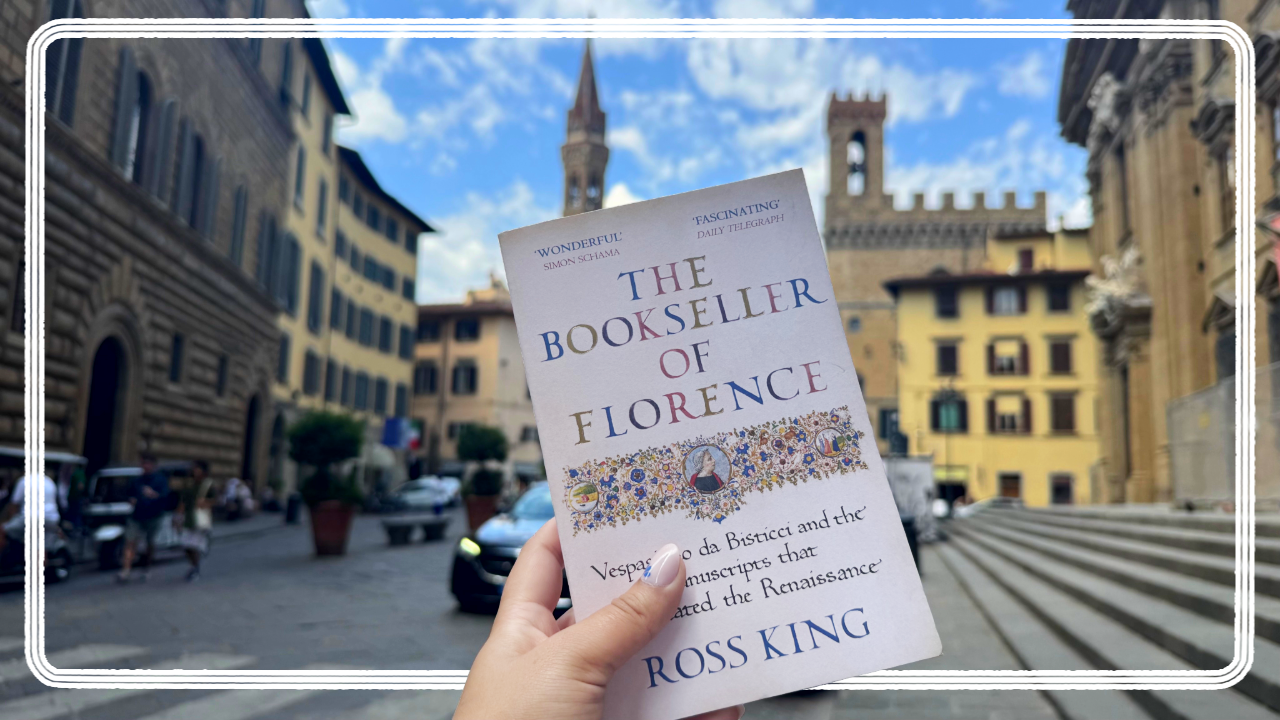
I was so enthusiastic about this experience that I decided to try out another of King’s books on Florentine history. The Bookseller of Florence covers the life of Vespasiano da Bisticci, the “king of the booksellers” during the rise of the printing press. Vespasiano’s clients were typically extremely wealthy (which often corresponded with extreme power). This meant he effectively Forrest Gump-ed his way through Italian history, rubbing shoulders with Popes and Dukes.
King attempts to weave three threads together in The Bookseller of Florence: Vespasiano’s life and business, contemporary Florentine history, and the rise of movable type printing presses. He lays out the traditional process of book creation – from sourcing the text(s), gathering the materials, hiring the talent, and guiding the production. King also lays out the early innovations from the Florentine book market (a more readable “antique” handwriting). But Florence was relatively late to host a successful printing press, and King argues that Vespasiano’s presence in Florence contributed. Towards the end of the story, King covers the rise of a competing press in a local monastery, and shows when Vespasiano’s clients preferred his effortful work to high-volume paper productions. (In today’s climate, I couldn’t help but draw parallels to the rise of AI and its impacts on publishing and software engineering.)
King is at his best when he’s writing about this kind of innovation and disruption. Unfortunately, life keeps happening in the middle of the story, and Vespasiano has to tend to his client’s whims. Unfortunately, there’s a limited number of rick manuscript buyers, and they keep getting into conflicts with each other. And so Vespasiano must walk a very fine line to serve them all without getting into too much trouble with a single one. Unfortunately, King establishes this all with extensive tangents into the details of political battles between different Italian factions – which feel a bit like a distraction from the major question of the future of the written word.
While I didn’t love The Bookseller of Florence as much as Brunelleschi’s Dome, it still revealed much about Renaissance life in Florence. Portraits of Vespasiano walking fifteen minutes to the Medici’s palaces felt much more real when tracing the same streets. And King brought to life how heady Renaissance Florence must have felt – all that innovation, attention, power, all concentrated in one place.
For the love of Firenze
I can’t finish this post off without telling you how much I loved Florence. Of course, there was the beautiful church. But there’s also the art (the David!) and the food (if you can find the right holes in the wall). The city also has a history of perfume that’s lovely to explore. And while the leather market is a bit overwhelming, you can find great workshops where you can see how the craft is done. The city’s overflowing with personal artisan experiences for those willing to look just a little bit.
The next and final stop on our tour was the Amalfi coast. Until then – stay cozy and stay curious!
