
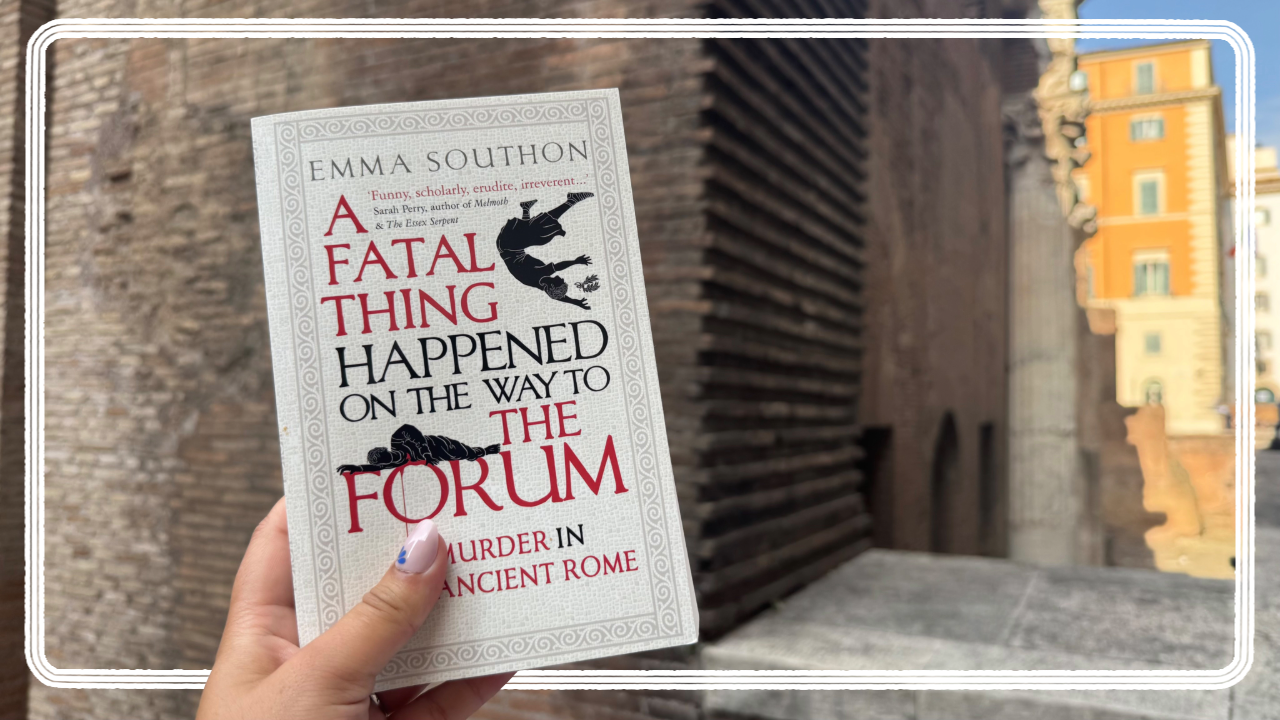
It is once again time for this blog to move from strictly reading-focused to a combination of travelogue with literary musings sprinkled in. Last year, we explored Spain and Nice; this year, I’ve gone further east to Italy. Specifically, I’ve spent the last two weeks roaming Rome / Lazio, Florence, and the Amalfi Coast.
There’s a bit of a twist this year – I’ve unexpectedly spent most of the time soaking in nonfiction about these places! Outside my usual comfort zone, but I’ve grown to really appreciate the layers of history in Italy via all this reading material. (And I was able to find plenty of interesting / quirky / unexpected nonfiction to gobble up, which certainly helped.)
A monastic start..
We started off not in Rome proper, but in the broader province of Lazio. My partner has an aunt in Manziana, and she was kind enough to show up around the town and the neighboring town of Viterbo. While there, we visited papal palaces (where the conclave was first incepted as a response to a two-year election) and subterranean tunnels used since the Etruscan era. It was my first taste of how layered the history is in Italy.
It was with eagerness, then, that I picked up Umberto Eco’s The Name of the Rose, a medieval mystery set in an Italian monastery. In Rome, we stayed in a gorgeous former monastery, balancing the beautiful art in the common spaces and the tranquility of the interior rooms. Given my experiences with “living the location” last year, I was excited to see how this perfectly-set mystery could bring our hotel to life…
…that led to a reading defeat

Unfortunately, I could not get myself through the book. I rarely DNF books, but I found it so hard to engage with this one. The Name of the Rose, structurally, starts a bit like Miss Pym Disposes or The Late Scholar. A Franciscan monk named William Baskerville, travels to a Benedictine abbey in Northern Italy, ostensibly for a religious negotiation. He immediately impresses the brothers with his powers of deduction. So when a murder occurs, the abbott asks him to investigate.
So far, so standard for a mystery. However, unlike most mystery novels, The Name of the Rose spends a lot of time exploring theology and politics. Because readers are likely unfamiliar with the intricacies of the Franciscan order and their rise in popularity, the narrator Adso spends thousands of words explaining them. For someone not raised in the Catholic faith, it was difficult to wade through pages of minor differences between sects. Adso expends great detail on the subtle manipulations of the Pope and the Holy Roman Emperor and their use of different sects to maintain their wealth and power. Apparently this almost conspiratorial perspective is typical for Italy – but that doesn’t make it easier to wade through.
Additionally, Adso is an adolescent. At times, this allows him to take on a Watson-esque role of charming naïveté. At other times, it leads to overwhelming descriptions of the world around him. For example, the monastery has an intricate portal, luxuriant in the way only medieval churches can achieve. Adso describes the portal – and his reactions to it – in painstaking detail. It’s clear from pages the awed narration that he’s unused to this kind of indulgent art.
It’s possible that this narration does, in fact, reflect the rich inner life of the average medieval monastic novitiate. But I found it tough to engage with, and even harder to relate to. Every day I was in the hustle and bustle of modern Rome, surrounded by ancient Roman monuments and modern boutiques. In the face of so many layers of civilization, it was hard to engage so deeply with what felt like a mere blip in the timeline. And that was when I found another, more interesting read…
A murderous entrée into nonfiction
I didn’t mean to quit The Name of the Rose – I try to make it through everything I start. But I’d spent my days exploring the Colosseum and the Pantheon and the cat sanctuary where Julius Caesar was assassinated. Ancient Roman history was in front of me in a way that’s impossible to find anywhere else in the world… And as I learned about gladiator games and Pantheon propaganda, I stumbled across Emma Southon’s A Fatal Thing Happened on the Way to the Forum in a bookshop window.
Perhaps strangely for a reader of fictional mysteries, I don’t read much true crime. And so I didn’t pick the book up at first – but I’m so glad I finally did. A Fatal Thing Happened on the Way to the Forum combines the hysterical and the historical. Southon snarkily interprets many layers of how Romans interacted with the concept of death and murder. Though the lens of murder, Southon explores concepts like Roman personhood, politics, and family. Slaves, for example, were absolutely non-persons, and Southon reflects on this theme several times. There were the laws that equated their murder to property damage, and the ability to command slaves as weapons in assassinations. And there’s the relative rarity of slaves killing their owners (due in large part to the horrifying punishments).

Southon’s skilled at returning to topics and expanding on them, making the Romans she describes feel complex and alive. Her narration humanized the Roman monuments for me, and as I passed by them on my way around the city I was able to imagine the men and women who came before me – their values, their priorities, their concerns.
Feminism from the Forum steps

In fact, I loved A Fatal Thing Happened on the Way to the Forum so much that I picked up Southon’s next book immediately. A Rome of One’s Own tells the history of Ancient Rome in 23 women’s stories. Southon makes deft use of historical specifics to bring the civilization to life. She’s particularly effective when she shows us how to read between the lines, triangulating across different historians’ reporting.
I particularly loved her tales of paired women used as foils, and her exploration of Roman values based on them. Boudicca, for example, is a well-known story of British resistance to Roman invasion. However, Cartimandua, her (perhaps more successful) contemporary is less known – and surprisingly reviled by Roman historians. Southon uses these two stories to demonstrate both Roman belief about female capacity and overall moral concerns of the time. She’s also not afraid to share her perspective on these interpretations. and credits Cartimandua for her deft use of Roman political systems to maintain peace in her realm. Her take on the rape of the Sabine women is similarly nuanced, directly addressing the problems with the male voice typically used to narrate the events.
A Rome of One’s Own covers “all” of Ancient Roman history, from the founding of Rome to the fall of the Empire (over 1000 years!). This extended timeline added to my feeling of laminated history as I wandered through Rome. Every monument or building seemed to carry thousands of stories. Layers were everywhere, on the remains of the Palatine Hill where Rome was founded and emperors sat, and in the churches dedicated to the earliest martyrs in the Empire. The Castel Sant’Angelo, first built by Hadrian, took on more meaning when I learned about his life and his entourage. Southon’s storytelling brought those ancient people to life, reminding me that, even across time, people are remarkably similar.
True stories of Ancient Rome
I am so glad I stumbled across Southon’s historical writings while in Rome. I’ve never been patient enough for ancient history – but Southon made it easy to follow. For those even remotely interested by my descriptions of her books, I highly recommend them! Reading about the ancient Romans made my time in the city and broader Italy much more engaging. And it laid a solid foundation for even more historical readings on our next stop, Florence / Firenze.
Next up – the city of art, architecture, and peak Renaissance vibes. Until then – stay cozy and stay curious!

2 responses to “Reading adventures, Pt. 7: Murder and marvels in Ancient Rome”
[…] interrupt your regularly scheduled travel/reading posts to bring you a staycation-themed travel […]
[…] Completed a fourth trip to Italy […]